Sunday, April 14, 2013

Methods of Language Learning in Japan

I remember talking to a taxi driver in Hakodate a while back. He told me about another foreigner who taught English in Japan. It didn't take long for that guy to get fed up with teaching, and he left the country with the lasting impression that Japanese people are just plain stupid.

Why? Well, Japanese students are moderately able to understand written English, but their conversation skills are extremely sub-par. I mentioned this before when talking about my speech contests students. They can memorize and recite paragraphs of difficult English, but they can't even answer when asked, "Did you study a lot?" It's an excruciating experience, being unable to communicate without writing everything down and giving them a few minutes to extrapolate a response.

As much as I empathize with the guy for his frustrating experiences, I don't agree with him. Yes, Japanese people seem to have a painstakingly difficult time picking up English. Sure, it gets frustrating. However, anyone qualified in the field of language teaching can easily tell why they're having such a hard time.

In a nutshell, it's the method they're using. It's hard to explain it in words, so I'll let this diagram do the explaining for me:


And herein lies the problem. Japanese teachers of English mistakenly believe that "native language" and "intended meaning" are the same thing. They believe that the only way to produce English is to start with Japanese, and then grind it through a grammatical translating machine. They think language is like math!

This becomes obvious when you see that English classes are taught almost exclusively in Japanese, no matter what the students' ability level. I looked at worksheets the teachers have created, and there are many activities that force students to translate each word in a sentence individually, and then do a big switch-a-roo in word order to abide by grammar rules. Imagine how hard it would be if you wanted to say something, like "I want to eat lunch." From the overall meaning, the Japanese sentence would be 「昼食を食べたい。」 Then you'd break the words individually apart, and translate directly into " lunch / eat / want to ". Then, you'd think of the grammar rules, and reorder the sentence into " want to / eat / lunch ". Then you'd remember the assumed subject, and finally end up with "I want to eat lunch." All the time it took you to read that explanation is how much time a Japanese kid takes to construct and say this sentence. I literally have to stand and wait for MINUTES for a simple sentence. That's assuming they know all the translations and grammar rules. If they don't, this could take exponentially longer, but they usually just give up before then.

No, no, NOOOOOO! That's not how language works!! Native language is not the benchmark to base all other languages on! A language - any language, even your native language - is merely a path to express a desired meaning. Overall meaning is the genesis where all language should emerge from!

When I tried learning Japanese the first time, it felt a lot like what they do in Japan. I was terrible, and I could speak almost nothing. After a few years off, I decided to start over and learn Japanese again in a different location. This time, we spent very little time translating English to Japanese. For only the first week, we memorized simple everyday phrases. After that , we focused on learning the Japanese language from scratch using the basic building blocks of grammar and vocabulary. Of course, certain concepts still needed to be explained in English, but the first year was spent slowly constructing genuine Japanese and weeding English use out of the classroom. By the beginning of the second year, classes were already taught purely in Japanese. Not a single English word was spoken by the teacher, and yet we all had no problems understanding.

This is why we were successful. We constructed Japanese out of the meaning we wanted to express, bypassing English altogether. Of course, we had to give conscious effort to construct the sentences, but it was still pure Japanese. These days, when I speak Japanese, I'm also thinking in Japanese, so I can have a conversation at real-time speed.

This is why Japanese people can't speak English. It's not that the kids are stupid. They've just been doing it wrong. And, until someone with lots of power decides to make a radical change to the system, they will continue to do it wrong. My role here is to be an assistant to the teachers that insist on doing it wrong, so there is very little I can do to make an impact. It's like watching children play with toy guns, believing that they are preparing themselves for real combat.

Maybe that's what that guy meant when he called Japanese people "stupid." It's not the people learning who are stupid. It's the people who are teaching.

Tuesday, April 9, 2013

Hilariously Lost in Translation

This post will be dedicated to some of the hilarious moments that occurred due to miscommunication/cultural differences:

1)
In elementary school, we were having a lesson on occupations. The teacher was telling kids what certain people do, and asked what the occupation was called in English. He got to the baker and asked, 「ぱんつくってる人は?」(pantsukutteru hito wa?). Some of the boys responded loudly with 「パンツを何??」 (they did WHAT with the panties?) because "pantsu kutteru hito" means 「パンツ食ってる人」, or "the person eating panties." The teacher repeated himself more slowly, saying 「パン、作ってる人」 (pan tsukutteru hito), which means "the person making bread." I laughed so hard I might have peed myself a little...

2)
In one of my elementary schools, I have the privilege of using this pointer:

Flippin' the bird at little kids
Nobody seems to know what it represents. Around here, it's not uncommon to see people pointing at stuff with their middle finger, but its still leaves me a little unsettled. One time, I fixed the glove so that it was the index finger doing the pointing. The next time I went back to that school, someone had reverted it back to the original form. I guess they just like the symmetry of the middle finger or something.

3)
At yet another elementary school, a 5th grade student had this pencil box:

Reefer for the little-uns
In this country, marijuana is strictly banned, to the point where possession of any small amount can get a foreigner jailed without trial for weeks or months, followed by deportation. Even so, the marijuana leaf symbol can be seen everywhere, strangely mostly on clothes and accessories meant for children. I've even seen ramen shop waitresses wearing bandanas with cannabis leaves printed all over it. It's just unusual to have the word "Marijuana" advertised so boldly on something, especially when accompanied by "I hear someone knocking on heaven's door." I laughed when I saw this pencil box, and the teacher explained to the child what it meant. I think the girl is considering getting a new pencil box hahaha.

4)
At one of my middle schools, some of the boys kept coming up to me and saying 「きらい だいいち」 (kirai dai'ichi). I was a little offended at first, because I thought they might be saying 「嫌い 第一」, which means "number one dislike," but they were using a different intonation pattern. 「嫌い 第一」 sounds like "kiRAi DAi'Ichi," but they were saying, "KIrai DAI'ichi."

After being confused for a few weeks, I found out that one of the second year boys, who everyone thinks is my doppelganger, is named 「きらい だいいち」 Kirai Dai'ichi, which I think is written as 喜来 大壱. This whole time, they were just calling me his name as a joke. I just never knew what was going on! I finally got it, and as I was chatting with their group, they all decided to nickname my clone "Kirai-en", or "Ki-Ryan". Fun times to come in the future...

5)
At my other middle school (you can see that I have many schools), the second-year kids were preparing a short speech about their "treasure" (See other blog post here for details). I was walking around helping the kids with vocabulary and grammar, when one of the girls raised her hand and called me over. 

She wanted to know how to say the word "uncle". I said it out loud, /ʌŋkəl/. She repeated nicely after me, "uncle." I realized it might sound a little like another Japanese word, so I replied with, "Yes. Not ウンコ ("unko", which means "poop"), but 'uncle'." Everyone in class burst out laughing, while the girl turned beet-red and repeatedly spouted 「言ってない!言ってない!」 (I didn't say that!). I laughed with them, and assured her that she pronounced it well so she would calm down. Then I told her to read her sentence, which was, "I got [my treasure] from my uncle." She snorted, while the boys around her shouted "My unko! From my unko!" I laughed until I had a splitting side-ache, and the room was in an uproar.

The Japanese teacher of English (JTE) had stepped out of the classroom before all of this went down, and everything had mostly settled down before she came back. When the girl read her speech during the presentation, and she got to the "my uncle" part, the whole class tried their best to stifle their laughter. We all ended up snickering loudly, and the JTE looked around in confusion. I had to excuse myself to the corner to regain my composure while the girl covered her red face with her paper. After regaining some self control, we calmly returned to doing presentations, with the JTE none the wiser. Ahh I love my second-year students.

6)
Before going on stage in the school opening ceremonies (for the new school year), one of the other teachers came up to me and slowly said 「二年の先生について いってください」 (ninen no sensei ni tsuite itte kudasai). This can mean 「二年の先生について言って下さい」, which means "please say [something] regarding the second year teachers." I was specifically told that I didn't need to prepare a speech, so I freaked out and asked her, "What would you like me to say?" She gave me a confused look, and then repeated what she said before, but a little faster. At natural speed, I picked up the intonation difference and realized that she said 「二年の先生に付いて行って下さい」,which means "please follow the second year teachers [up the stage]." I breathed a sigh of relief, and angrily muttered to myself, "you coulda just said it like that the first time..."


Thanks for reading! If any other funny stuff happens, I may make a new post, or just add more to this post. Stay tuned!

Sunday, April 7, 2013

Trip to Nagano

Since I came to Japan, I've been down to visit my girlfriend in Nagano twice. She lives in a sleepy town called Komagane, boasting a population of 30,000 people and nestled in a valley in the Japanese Central Alps.

I usually avoid going down to visit her. The town itself is very hard to get to because it's so tucked away, so the nearest bullet train station and airport are hours away. I always take the highway bus, which is cheap (about ¥2000 one way) but takes about 4 hours from Tokyo (not including the additional 10 hours overnight from Aomori to Tokyo). She also lives in a very small apartment about the size of a single-person college dorm room, with added tiny bathroom and kitchenette. In town, there is very little to do, especially when you don't have a car because the bus system is insufficient. Essentially, it's a pretty big waste of time and money to go down to Komagane compared to having her take a trip up to Aomori to visit me.

Nevertheless, it's necessary to give her a break from traveling once in a while and return the favor. This past long weekend, I made the trek down to Komagane. The first time I visited, we hardly did anything because she didn't really have a good idea of the area. This time, we had done more planning and rented a car, so there was more to occupy ourselves with.

First, we went to 光前寺 (Kozenji Temple). I've been a little tired of visiting shrines and temples lately (there are just SO many), but this one was pretty special. Everything was built out of untreated wood, so the structures looked very natural and blended well with the tall cedar trees surrounding the area. They were all very intricately carved too, and I admired the craftsmanship. However, untreated wood is also defenseless against pests, so bugs burrowed millions of tiny holes into the pretty pagoda.

Amazing untreated wood.
The pests thought so too. They didn't allow people to stand on it because it was so structurally compromised.
Next, we shifted over to a nearby riverside park to relax. As we walked through the long but somewhat barren park, we got to a playground area. There was a climbing wall (which was unfortunately cordoned off) as well as some really nice playground equipment, like a long roller slide and a rope climbing tower. Always one who likes to frolic, I raced my girlfriend up and down the rope tower (she lost both times and called me a monkey), and then we took a ride down the slide. Roller slides are fast and fun, and give you a good massage on the way down too!


We got hungry, so we decided to try a Brazilian food restaurant the other JETs recommended. We had a hard time finding the place, and when we finally walked in, we were greeted by the most apathetic people I've ever met. No greeting. No showing us to our seats. No handing us menus. All we got was a stare from a gangster-looking tattooed Brazilian guy at the bar and a glance from the woman in the kitchen. It almost felt like we accidentally waltzed into their living room and they wanted us out. Anyways, we sat down where we wanted and scrounged up some menus from another table. As we were about to order, it dawned on us that we had no idea what language to order in. The menu was entirely in Portuguese, and not a single Japanese word was written anywhere in the shop. Kristin just did her best using Spanish pronunciations to order some sandwiches (that was all they really had), and sat back down. While we were eating, nobody else came in except for another gangster-looking Brazilian dude, who biked up on his expensive downhill bike and fist-bumped the other guy before joining him at the bar. We just finished as quickly as we could and left. Outside, we were baffled by what just happened, and how the hell a shop like that could survive, let alone even exist, in this place. Awkward.......


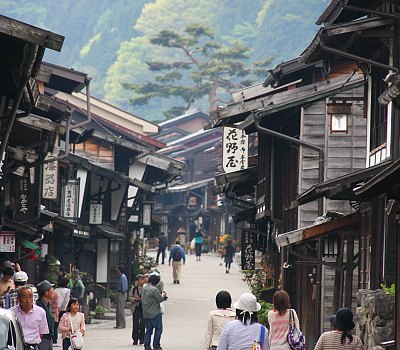
With out bellies full, we drove through a tunnel to get to another valley called Kiso Valley, home of the Kiso Post Towns. These towns are historical trade points of the Kisoji, an old trade and travel route connecting the old and new capitols, Kyoto and Tokyo. The town we went to was called Narai, which was the richest of the Kiso Post Towns back in the day. It turned out to be more boring and less authentic than I was hoping. The preservation area itself was only a single strip running through an obviously more modern town. Many of the "preserved buildings" were merely more modern buildings disguised as traditional ones. The road is paved with cement, and cars swerve through occasionally. The box style lamps hanging from the buildings seem traditional, until you realize they run on energy-saving compact fluorescent bulbs. The place was pretty deserted, as it was a cold and windy day. Many of the places were closed, and the places that were open tended to be shops selling stereotypical Japanese trinkets for exorbitant prices. I will not pay $30 for a little wooden comb, thank you very much. The whole place just reeked of "tourist trap." It was such a let down that I didn't even feel obligated to take a picture of the place, so you'll have to settle for a stock photo.

Narai-juku on a warmer and busier day.
Taking a break from all the disappointment, we stopped in a small shop to eat some of the local specialty: お焼 oyaki. Oyaki is a fried, steamed, and flipped bun stuffed with different kinds of goodies. We ordered ones filled with pumpkin, 野沢菜 "nozawana" pickled greens, and しめじ "shimeji" mushrooms. They were quite good and surprisingly inexpensive, and helped to lift my mood. We took a 肉まん mean bun home with us before we left the town for good.

Different kinds of oyaki. We had the three on the left.
That night, we decided to get some pizza. I haven't had pizza since I came to Japan, so hooray! We went up to a place called Oz Pizza, which turned out to be a B&B cabin in the woods in the foothills. We ordered a pepperoni pizza, which was fresh from the wood-fired stove. It was ridiculously expensive ($35 for something equivalent to a small pizza), but it was nice to actually have some real mozzarella cheese instead of the sweet candy-like dairy product Japanese people like to call cheese.

That pretty much ended the bizarre weekend. The next day, before I got back on the bus and headed back home, we ate lunch at a local gyoza shop that Kristin had always wanted to try. It was run by a nice old lady with golden teeth, and their prices were fantastic. We both got set menus, and shared the mapo tofu and gyoza that came with them. The gyoza were tasty and stuffed to the brim, unlike the loose saggy ones with very little filling at other places. Kristin kicked herself a few times for not trying the place sooner, and we left to the bus terminal.

Goodbye Komagane, and here's hoping that we never encounter each other again!


Solo Day

This past weekend, when the weather was beautiful and possibly even considered not cold, I decided to take a day and go explore the west side of the city by myself, with nothing other than my bike. The title is a bit strange, since I tend to do a lot of stuff by myself around here, but it was nice to go out and do things at my own pace. I wanted to see how far I could get before I pooped out, since I'm hoping to ride a roughly 40-50 km trip up to Mt. Hakkoda and back during the spring.

For now, the original plan was to ride along the curving coastal highway going northwest, and see how far out of the city I could get. The day before I left, I was looking through a picture book of the region, and I happened across a picture of 野木和公園 Nogiwa Park, with beautiful bridges going across a picturesque lake. I decided I'd take a western detour to bike around the park before continuing north. I also looked up a ramen shop called ラーメン二八〇 「ニッパーマル」 (since the highway is called the 280) far down along the highway, which I could use as a rest stop/landmark.

And so, around 11:30 am after a breakfast of rice, natto, and a quarter of a honeydew, I set out. The roads in the city are bumpy and crowded, and no fun to ride. I ground through it over the bay bridge, and finally made a left in 油川 Aburakawa to get to Nogiwa Park. None of the paths going through the park are paved, so I stayed along the road that winds around it. The lake itself had not yet completely unfrozen, and still had large chunks of ice covering most of the water surface. I wonder if there are any ice skating activities here during the deep winter, although perhaps the deep snow and not-quite-low-enough temperatures make it impossible. Even though the ice wasn't all melted yet, the lake shore was teeming with fisherman, so I guess this is a local fishing mecca.

Nogiwa Lake, filled with slushy water.

I took half a loop around the east side of the park (which ended in a dirt road), and then wound back around to the west side. I saw a road sign and asked myself, "Do I want to go to 五所川原 Goshogawara?" which is maybe 40 km to the southwest. I thought about it, and decided, "Nahh..." but then I saw the road...

Sweet mother of road biking...

Luscious curves and gentle hills, occasionally enveloped in green pine forests and lined with unadulterated white snow like icing on a cake? How can anyone resist that? So, I rode up this winding, silky smooth, and absolutely empty road for a few miles until I hit a roadblock that said, "Closed for the winter." So that's why it was so empty...

Having been forced to turn around, I rejoined the coastal highway and continued north. A south-blowing wind of around 5 m/s made the riding slow and excruciating. I kept plowing on hoping for the ramen shop sign to appear around the next bend. After a grueling who-knows-how-long, I finally made it to Ramen 280 next to 北中). After re-teaching myself how to walk on solid ground, I stepped inside.

The place was mostly empty, except for the chef and one guy in the corner taking his sweet time reading a magazine. This was great, because I could stretch my poor legs without people judging me. I ordered the shop's specialty, 味噌担々麺 (miso tantan-men) and sprawled out on the tatami in the unoccupied corner to stretch and watch some daytime Japanese television. When my food came, it didn't disappoint.

Miso Tantan-men
It had a sweet and savory flavor made through the use of lots of sesame sauce. It was also filled with chashuu pork and an indescribable ground meat that formed a pebble soup-bed underneath it all. I thought it wasn't that spicy at first, but then the mouth burning slowed my pace way down.

I checked out the wall behind me, and apparently this shop has a spicy ramen challenge. On the left, it says 眺望山「噴火」ラーメン Choubouzan Funka (eruption) Ramen for 800 yen. It advertises that the ramen is very spicy, but if you finish it, soup and all, in under 28 minutes, you get it for 280 yen. I think I'll pass and just come back on the 28th of every month, when the 正油 shouyu ramen is 280 yen. Notice a theme?

やんべ、やんべ、チョウやんべ!
Anyways, after chilling out here for about an hour, I finally felt ready to go again. I started heading north even further, but the wind demoralized me so much that I turned back around after a kilometer or so. The ride back home was fast and easy with the wind behind me.

After getting home, my legs were surprisingly fine. I'd clocked in a bit more than 40 km, and yet 2 days later I still don't feel anything especially sore. I'll probably still need to do some more training before taking on Hakkoda, and I'll try to go further down that fine road towards Goshogawara once it opens up again. In any case, I felt a bit accomplished, even though I spent the entire day by myself. I'm used to it by now, I suppose, but it'll be great once my girlfriend can finally come up and live with me again.

Tuesday, March 26, 2013

Treasures at the End of the School Year

It's finally time for the school year to end!

I've spent 2 out of the 3 semesters this school year teaching these students, and I've become much closer to certain groups of them than others. I didn't visit my big elementary schools enough for the kids to know much about me, but the kids at my small elementary school are already very used to my presence. I attended their graduation ceremony and watched them choke back tears. Afterwards, I went to their room to congratulate them and give them all hugs. I lifted some of the more excitable boys up in celebration, and then went around to gently hug the girls. One of the girls wasn't satisfied and demanded that I lift her in the air as well. I have a feeling it'll be easy teaching these kids next year in middle school.


In middle school, I didn't spend much time with the 3rd years. They spent most of the time studying for their high school entrance exams, so I was used mostly for 1st and 2nd years. The first years had teachers that didn't let me do much (for some reason or another), so they are all kinda awkward and nervous around me. They're at that awkward stage in life anyways.

The second years are the kids that have spent the most time with me. I feel a lot closer to them now, and some of them like to talk to me about anime. I always feel comfortable in the second year classes, and we sometimes mess around during P.E. and break time. I joined the girls for badminton on one P.E. session, and I ended up with a certificate for second place in doubles (I played with a girl named Nene, and we destroyed opponents together. I wasn't there for the second session, when the P.E. teacher took my place and lost some games, knocking us down to second =[ ).


At my other middle school, the second years always say hi to me with big smiles when they see me. One of the girls is particularly obsessed with American music, and she excitedly asks me about the songs I like (even though I'm a little behind on the popular stuff). The boys are really energetic in a foolish way, so I participate in their horseplay. I taught some of them the exploding fist bump, and now that's all they want to do. Everyone thinks that one of the boys, named Kirai, looks just like me, so they've nicknamed him Ki-Ryan. One of the kids I like to mess with is a bit of a bully, but in a gentle giant kind of way. He is quite a bit larger than me and has absolutely no English ability, but he seems to like to interacting with me. He sometimes goes around kneeing other boys in the belly. I saw him doing this once, and I trotted over to give him a nice dead-leg roundhouse knee to the thigh. The other boy said, "Ohh, thank you Ryan-sensei! You're a good guy!" Another time, he picked up my bag of candy and pretended to start walking away with it. I chuckled, and he asked if he could really take it. I said, "Sure! Go ahead!" while cracking my knuckles in a fist. He looked back at me with doubt, and I said with a broad smile, "It's been a while since I've had someone to play with!". He paused, slowly put the bag down, and walked out of the room. He turned back around and asked, "When are you coming back next time?" I smiled and said, "Two weeks," and he turned around with a nod. Dawwww you're so adorable.

For the last few days of school, I spent a lot of time with the second years. The final activity was a short speech on something we value the most: our "treasure". I wasn't sure what to use, since there are so many things that I value (hapkido belt, girlfriend, birthday watch, Wheatley keychain light, etc.). I decided to just make it simple, and used my bike for the example speech.

My treasure? Sure... it definitely falls in the price range...

I really enjoyed walking around to each student and helping them with their spelling/grammar while talking about their treasures. Some of the kids came up with some really interesting stuff. Several kids loved their pet tortoises, and one girl even chose her cactus as her treasure. Another boy chose to talk about his "thought", and even had an impressive set of existentialist supportive reasons written down in English. A few kids valued their watches, and I showed them the one I got from my mom for my birthday. One boy valued his Kyokushin Karate brown belt (called an obi), and he recoiled with a surprised "Ooh!" when I whipped my red belt out of my bag (I used it as my prop treasure for the first years earlier that day). One girl really liked an anime folder she got from her brother, and she told me the anime was very interesting. I'm now watching the anime she recommended, and it is indeed quite good!

After they had their speeches written and proofread, they then volunteered to come up to the front and speak. My favorite class had nearly everyone participate (24 out of around 30 people), and the teacher was really impressed. One of the girls originally chose to pass, but I was like, "Whaaaat? Come on, come on!" and waved her up. She called her teacher over to help her while the rest of the class finished their speeches, and she finally mustered the courage to go up at the end. She's a really quiet student, who I've bumped into at the 100-yen shop and tried to talk to before, so it's nice to see my encouragement having some impact. This class is my favorite because they are the most willing to use and improve their English (and the cute girl ratio is way higher than any other class =P).

As second year English classes came to a close, I went back to the teachers' room to wallow in loneliness and think about what will change when they become third years. Suddenly, pancakes started flowing into the teachers' room! I ran over to the home economics room, and there were my second years, making pancakes and sending extras to the teachers! I wanted to cook too, but right when they saw me, they yelled, "Ryan-sensei is here!" The home ec teacher saw me, and told someone to grab a plate and shove it in my hands. Apparently, they were all done cooking and were eating already, so I dug in. It was only one pancake, but it was smothered in all kinds of goodies: strawberries, banana, jam, crushed red bean, and lots of whipped cream! The boys were playing with the left over whipped cream, so I told them to lay some more on me. Then, as a girl scooped the last dollop out of the bowl and verbally wondered what to do with it, I opened my mouth with an "aaaaaaahhh" and she fed it to me. Best final day of classes ever!!

The last two days consisted of tests and ceremonies, so there were no classes held. I took the first day off to go fail my driving test, but I showed up the second day for the ceremonies. The first ceremony was the basic end-of-the-school-year ceremony. The second one was a farewell to the teachers who are transferring to different schools. The tears flowed freely, and even the third years (I though I'd never see them again) showed up to say goodbye.

After that, we had a short meeting to congratulate the departing teachers on their hard work, followed by a special bento lunch prepared by the Washington Hotel. It was massive:


A feast for a job well done. For scale, the textbook on the top left is about 8 inches wide.
Here's the contents, if you're curious.

It took me a while, but I managed to finish it all! Afterwards, I said my "thank you"s and "farewell"s to the leaving teachers, and departed back to my central office. It's finally over, and the schools will never feel quite the same.

Thanks for reading, and see you again!

Monday, March 25, 2013

Hinamatsuri

Hey everybody!

Today, I'd like to talk about Hinamatsuri. Also known as "Doll's Day" or "Girls' Day", Hinamatsuri is a special day celebrated on March 3rd (so you can tell this post is a couple weeks late).

Hinamatsuri has always been traditionally celebrated with the use of dolls. The word "hina" 雛 itself means "doll". In the olden days, paper or straw dolls were made and floated down rivers. It was believed that the dolls could contain bad luck, so floating them down the river was a way to remove bad luck. Since these dolls ended up being snared in fishermen's nets, this practice is no longer continued.

These days, Himanatsuri is widely celebrated through the arrangement of a large doll display. These dolls represent the imperial house, and are placed on a large 7 tiered platform.

Platform to the right, and partially assembled dolls in the foreground.
After a short trip into the nearby shrine to have a ritual prayer performed, we began to dress and ornament the dolls with their respective hats, weapons, and accessories. We then placed each doll in their respective place.

Musicians and Court Ladies

Soldiers and Ministers

I had the honor of re-tying a hat onto one the musicians after somebody else pulled it loose. With the tiny string and the tight quarters, it was like brain surgery. Everyone watched and waited as I tried my best to finish it quickly.

Everyone doing their share.

To be honest, even the old Japanese folk weren't quite sure what went where, but this is how it is supposed to be arranged:

Top Tier: Emperor and Empress
Second Tier: 3 court ladies w/ sake equipment
Third Tier: 5 musicians (3 drummers, a flautist, and a singer)
Fourth Tier: 2 ministers
Fifth Tier: 3 soldiers/samurai
Sixth Tier: furniture
Bottom Tier: lacquered boxes, a palanquin, and an ox-drawn carriage

The completed display.
After completing the display, we listened to some bamboo flute music from the priests at the shrine. I would upload it, but it was pretty grating and out of tune, so I'll spare you.

Finally, we helped prepare some food to match the occasion. Using rice colored pink with food coloring and salmon flakes, we rolled some sushi in the shape of a peach flower. Peach flowers are usually representative for girls, while cherry blossoms represent boys. Some of the other housewives made rolls with hot dogs and cucumbers in the shape of peaches.

Our flower sushi.

Fancy peach-shaped sushi rolls.
We also drank some clam soup, which is also a popular food on Hinamatsuri. It is said that clam shells represent a perfect marriage, because no two shell halves fit together perfectly except the ones from the same clam. After that, we watched as everyone took down the doll display we had just worked hard to put up. Apparently, leaving a display up after Hinamatsuri ends means that the daughter of the house will have a late marriage.

That's all for this time!

Sunday, March 17, 2013

Driving in Japan

Hello again,

Now that winter is coming to an end, my first year here in Aomori is nearing completion. Upon this landmark comes the realization that soon, I will not be able to drive an automobile.

Before I came to Japan, I had no idea whether or not I would need a car. It turns out that the Board of Education had decided for me. They forbade us from driving during working hours and highly discouraged car ownership. I later found out that in the past, a JET was killed in a car accident during working hours, and the BOE was forced to pay a lot of money in working insurance because of it. So, of course, the only way to prevent a person from breaking a finger is to cut them all off. That's the logic of the BOE, anyways.

Even though I knew I wouldn't have a car, I still wanted to be able to drive a rental car. One of the great things about Japan is that you don't need to be 25 years old to rent a car like in the States. Budget rental companies are reasonably cheap (as low as $18 for same day pick up/drop off), and it's by far the best way to make a day trip in the local region. Public transportation can get very expensive, especially when traveling far or with a group of people. Trains and buses don't always go where or when we want to, so rental cars are convenient and cost-effective.

If you possess a US driver's license already, you can go to AAA and obtain an International Driving Permit for a small fee of $15. It contains translations for many countries, and is valid for a year after issue. You just need to make sure you keep your original driver's license with it for it to be valid.

International driving permit, but soon to be scrap paper.

The international driving permit is renewable every year. However, the rule is that you must be in your original country for at least 3 consecutive months before you can be issued another one. The JET program will terminate you immediately if you are out of Japan for 60 days of any year, so being in America for 3 months is impossible.

After my international permit expires in the beginning of August, the only way for me to be licensed to drive is if I obtain a Japanese driver's license. For some countries, like Australia and New Zealand, all a person needs to do is fill out some paperwork and take a simple written test, and their driving permission is transferred to the country of Japan. Unfortunately for me, the United States is not one of those countries. I used to be able to drive a 40-foot-long bus with as many as 70 people inside, and yet all I can drive with my license alone is a small single-person non-highway moped.

I've heard several explanations as to why this is. Firstly, the US driver's license system does not operate at the national level. Instead, each state issues different driver's licenses under slightly different driving law. This makes creating an international driving treaty - for the US as an entirety - a gigantic bureaucratic pain in the ass (and Japan is the king of bureaucratic pains in the ass). Secondly, apparently Japanese drivers are not immediately allowed to drive in the US either (thank goodness, since they're wild lead-footed wheel-slingers), so there is a reciprocal resentment between the two countries about this matter. Whatever the explanation, I'm shit out of luck.

For me, I need to make an appointment for a written AND driving test. First, though, I need to get my license translated at the Japanese version of AAA, the Japanese Automobile Federation (JAF). They also collected 3000 yen from me for the service, which literally involved one of their people printing out a page of Japanese and doing "fill in the blank" and "check the box". I also bought an English copy of the rules of the road for 1000 yen. That's right, you must PAY to find out what the road laws are.

A very expensive and useless piece of paper.

After that, I can go to the Japanese DMV (called the Menkyo Center) to take the written test and driving test (for a fee of about 2000 yen + 2050 yen issuing fee if I pass). The driving test here in Japan is nothing like that in America, where you drive on real roads for a few miles. Here, you must methodically go through an empty driving course, performing a routine that you must memorize beforehand. It's not so much a test of real driving skill, but more an examination of your ability to memorize and follow directions to a T (which is very typical of Japanese tests).

That would be great and all, if they provided us with good directions to begin with. Before the driving test, they hand you a sheet of paper, with lines showing your route and areas where you must get up to a certain speed. They fail to mention the formalities of the test, though. They don't tell you that you need to walk around the car and check underneath for children/animals. The don't tell you the exact order in which you must look over your shoulder, turn on your blinker, edge over to the side of the lane, check over your shoulder again, and then turn. They don't tell you when it's okay to back up out of a tight turn, and what is an immediate fail. If you don't know these exactly, you will fail.

Why don't they tell you? Well, on the other side of the driving course (yes, the same driving course the Menkyo Center uses), there is a driving school. If you fail the test, the instructor will advise you to go to driving school, where they charge you 5000 yen per one-hour lesson. At the driving school, they will not teach you how to drive well, but instead instruct you on exactly what procedure you need to perform to pass the driving test. Basically, they are all in cahoots to squeeze as much money out of you as possible. The JAF; the Menkyo Center; the driving school; all of them are in on it, and it stinks. It just reeks of corruption, but it's perfectly legal.

The worst part is, it's not even that bad for us foreigners. Japanese people MUST go through a driving school and then test at the Menkyo Center to get a driver's license. In total, the expenses to get through the process are about 300,000 yen, equivalent to about $3000! How can they charge such an exorbitant amount without challenge or competition? Here's the story...

When a high-ranking police official has done his many years of duty, he generally "retires" into a well-paying position at the top of a driving school. Here, he has connections with the people at the Menkyo Center, and can pretty much pass or fail anyone at will. People who pay their tuition and attend driving school are almost guaranteed to pass. Anyone who tries to fight these people are nearly guaranteed to fail. I've been told of a Japanese teacher who had to take the driving test a whopping 8 times before he finally passed! It seems like he was less than polite to one of the instructors, so they failed him until they didn't feel like failing him anymore.

Meanwhile, since anyone with the money can get a license, Japan has an epidemic of problem drivers. Anyone who's driven or ridden in a car in Japan knows that Japanese drivers are the craziest bastards out there. They park wherever they want, even if they block traffic. They swerve dangerously around stopped buses. They do anything just to pass a few cars, even if it means driving in the median or against opposing traffic. They speed beyond belief.

On the other side of the spectrum are the infamous "paper drivers". These are people who have gone through the process of obtaining their license, but haven't a clue on how to drive on real roads. Because driving schools have prepared them so little for the actual world, they live without a vehicle and in fear of the day they will actually need to drive. My former Japanese language teacher was one of these paper drivers.

For me, things can be somewhat expensive, but it's not nearly as bad as it is for Japanese citizens. Also, it is entirely possible to pass the test in one try, as a fellow teacher did a few years ago. All the JET teachers who have taken the test have compiled their advice and instructions into a single document to help us pass as easily as possible.

Soon, my time will come, and I will keep this blog updated with the details. Thanks for reading, and see you again!

***UPDATE: I went to the driving center today and took the test. After a strangely long and specific inquisition of my previous driving experience and practices of the California DMV, they gave me a short written test. It was in English and only 10 yes/no questions long. Some of the questions were laughably easy, like the one that asked, "Should you [do something] safely?" No...

After scoring a perfect on the written test, I moved on to the driving test. As expected, the course is actually really short once you're driving a car, so I was kinda rushed to get in all my blind-spot checking. Halfway through, the tester told me I had failed, and I'm still not entirely sure why. I used the rest of the time as practice, and then the tester reviewed the things I had done well/poorly. He said I was checking surroundings very well, but that I was driving too fast through the turns. I actually drive comparatively slow (I'm a bus driver for god's sake), so I'm guessing they really want me to crawl through the course (I was already driving below 20 kph for most of the track). In America, we'd call that "obstruction of traffic", but alas this is not America.

The second thing he mentioned was that I wasn't edging to the sides far enough before making my turns. In Japan, they want you to scoot over to scrape the very edge of the lane in the direction you're going to turn. I find this dangerous, but that's apparently what they want. Finally, after he told me I had failed the test, I stopped at a stop sign slightly past the painted line. I was kinda distressed so my concentration slipped a little, but I knew that signaled an automatic fail (whatever, he already failed me anyways). He may have failed me for this reason at a previous red light, but I know for sure that I stopped before the line. My first driving tester back when I was 15 also docked points for stopping past the line when I actually didn't. It seems like, internationally, people don't understand that just because you can't see the line any more doesn't mean you've crossed it. It seems like I will need to stop yards behind the line to make these fools understand...

In the end, I'm frustrated that I need to go back to the driving center to test again. It also seems like there will be some driving school in my near future, although my pride is screaming at me not to. I am far too qualified a driver to be willingly dragged into this bureaucratic bullshit, and it doesn't help to know that I probably have more logged miles and driver training than the person testing me. But, what choice do I have?

***UPDATE AGAIN: I've done it! I finally have my Japanese driver's license!

I went to the driving school and forked over $50 for an hour of behind-the-wheel training. I would say that it helped a lot, but all I really learned is that the testers want me to drive achingly slow on the course. Anybody who has taken the test before could have told me that for free, but nobody did.

Basically, they want me to make turns at walking to jogging speed. If they even feel the slightest centrifugal force while turning, you're going too fast. Imagine if you were turning on a sheet of ice, and that's the speed they want. Also, when braking, they want you to stomp repeatedly (and annoyingly) on the brake and come to a stomach-lurching halt. Originally I was instructed to do this on the written guide provided to me, but I didn't because I thought it was too comically stupid to take seriously. Well, apparently "comically stupid" is the Japan-approved way.

Anyways, I paid a large sum of money for a guy to tell me this and give me some practice (which ended up being only like 40 minutes, since I had no problems with the course obstacles and driving around at crawling speeds get's tiresome after a while). The next day, I showed up at the licensing center, late, soaking wet from biking through a sudden downpour, and without a translator. Despite what people tell you about "leaving a good impression", I passed easily this time, and then waited around for an hour or so before they handed me my new driver's license! Here she is:

Ain't she a beaut?
Yay! Now I can rent cars and drive around as much as I want! That being said, if anyone is taking the foreigner driver's licence test in Aomori anytime soon, don't waste your money on driving school. Send me a message and I'll let you know everything you need to do to pass. Of course, if you have trouble with the actual physical driving part of it, then you're on your own. =P