Monday, May 13, 2013

Golden Week Part 1: Hakodate


I have a friend I've known since middle school named Kevin. We played trombone in the same marching/symphonic/jazz bands all the way through high school and studied Japanese together for years. We're both engineers, and we even lived in the same condominium in college. Needless to say, we've got a long history.

Kevin and me at our graduation
Kevin decided to quit his job and go on a journey to Japan and Taiwan for a month, before returning to the US to find a new job. A friend we met at Anime Expo, named Wesley, decided to tag along. They just happened to come during Golden Week.

Golden Week in Japan is heavy travel season. It is a period of consecutive holidays partnered with a weekend, so most people take their vacations during this time. If you want to go anywhere in Japan, it'll cost you 2-5 times as much as it would during an off-season. Apparently, this price hike used to be illegal, but the government decided that the ability to rip people off is a cornerstone of capitalism and should be allowed. Thank you Koizumi Jun'ichiro. Anyways, since hotel prices skyrocket like crazy during Golden Week, these two friends avoided highway robbery by visiting me and using my apartment as their staging ground.

I figured it would be too boring for them to stay in Aomori City for a whole week, so I planned my second trip to Hakodate. I love Hakodate because it's lively and interesting, while decently cheap and easy to get to by ferry. Also, since it was no longer the dead of winter, there were more attractions for us to see!

Since my friends hadn't seen them yet, we went back to the obligatory Goryoukaku Star Fort, Bugyousho (Magistrate's Office), Mt. Hakodate Ropeway, and the scalding Yachigashira Onsen. Here's a few pictures:

Bugyousho in the spring
Panorama of Goryoukaku grounds and Tower
Afterwards, we continued down the cable car line to Yunokawa to take a look at the Onsen Ryokan area. There was a nice footbath near the cable car station, and we warmed our cold feet. My girlfriend, unfortunately, was wearing a tights/socks combo thing, and couldn't get them off without stripping down, so she sat miserably beside us and took pictures.


From right to left: bare-legged local, happy Kevin, and sad Honeybunny

Ab and quad workout air-drying our feet since we didn't have towels. If you look closely, you can see the red/white boundary line where our feet had been soaking in the water.
 
I was starting to feel a cold coming on, so that night, we ate some of Hakodate's specialty 塩ラーメン (salt ramen). We went to a tiny shop in Daimon Yokochou called Ryuou Ramen, where they have a well-advertised 黄金塩ラーメン (Ougon Shio Ramen) "Golden Salt Ramen". When the stuff came out, it didn't disappoint. The stock is made from boiling chicken for ages and comes out a golden yellow. The sweet richness of the molten chicken fat blends perfectly with the added salt and chewy, fresh-cut ramen noodles. I will definitely be back here someday.

黄金塩ラーメン: one of the best I've had in Japan!

On the way back to the hotel, my girlfriend frantically came to me saying she left her phone in the ramen shop. I turned back to go get it, but she told me to stay at the hotel while she went back to get it herself. That sounded fair enough, but I later found out that she had gone to buy a birthday cake for me from Pastry Snaffles, a popular pastry shop in Hakodate with a killer cheesecake. I had almost forgotten that my birthday was coming up until everybody strolled into my hotel room with the strawberry cake. "What's this?" I asked in confusion. They answered with the Happy Birthday song. Ahaha you all totally got me!

The next morning, we went to the nearby 朝市 morning market to get breakfast. We headed straight for the live squid pool, where you can fish your own squid for a little less than 1000 yen. The shop then guts, cleans, and slices your catch for you to eat right away. I'm not much of a fan of squid, but it actually tastes amazing when it's this fresh! It so fresh that the tentacles still curl and writhe when you dip them into soy sauce!


After a bigger breakfast of crab, raw scallops, and sea urchin eggs (Kevin ate a whole grilled mackerel!), we headed north to Ounuma Park. Ounuma Park sits in a small land strip between Ounuma Lake and Konuma Lake. Each is riddled with small islands, which are connected by bridges making a hiking path. The park also has a 14 km bike route (along the road) around Ounuma Lake, and there are many bike rental places that offer bikes for 500 yen an hour (1000 yen for a whole day). It was beautiful, but with the temperature still sitting below 10 C, it would have been nicer if it were warmer.

Ounuma Lake and Mt. Komagatake
As the day ground to a close, we took the train back to the city and paid a visit to the familiar Hakodate burger joint, Lucky Pierrot. This time, we went to the original store in Motomachi near the red brick warehouses. We were all wildly satisfied with our chili-filled hamburgers, except for Kevin, who thought his tonkatsu burger was a bit dry.


Disappointing tonkatsu burger
After wandering through the red brick warehouse looking for souvenirs, we finally called it a day and walked back towards the hotel to gather our things. Along the way, we stopped at a cool-looking boat-shaped footbath near Hakodate Beer. After quickly removing our shoes and socks, we 3 boys recklessly plunged in to discover that the footbath wasn't even lukewarm! Lesson learned: always check the water temperature before going in!

After another 4-hour ferry ride filled with UNO and middle school kendo kids staring at us, we arrived back home in Aomori! Stay tuned for the rest of our Golden Week travels!

Katakuri Festival (Dog-toothed violets)

Before I was even off work, Kristin arrived from Nagano to visit me for Golden Week. She arrived just in time to catch the end of the Katakuri Festival in Asamushi Onsen.

Asamushi Onsen Beach during peak summer season.

The Katakuri Festival runs for a few weeks every April and celebrates the blooming of the dog-toothed violets. In many respects, it's not so much a "festival" as it is a "hiking and photographing frenzy". During this time, small fishing boats offer 1000 yen rides over to 湯の島Yunoshima, the uninhabited island in front of Asamushi Beach. There, you can hike up to the peak of the small but steep mound of an island, and look at the purple and white flowers around you all the while.


I instantly fell in love with the trails. They're narrow, soft, and have massive steep drops off to the sides. It's great that the island is off-limits for most of the year, so the trails stay wild and mostly untrodden.

Trails used only a few weeks a year are the best trails!

Once we got to the top, Kristin and I sat down and munched on some apple pie and pumpkin rolls we bought at a grocery store on the mainland. We washed it all down with some local Aomori apple juice before heading back downhill.

The summit: short but steep.
At the bottom, we spent a little time walking the rocky shores taking pictures and hunting for sea glass.

So much smelly marine life.
Mmm... shellfish...
Tiny rocky beach on the north end of the island.

We walked past a smelly pile, and right as Kristin was about to step in it, I said, "Hey! Look at this!" She looked down to see the decomposing jaw and spine of what used to be a fox. She stumbled back in horror, while I contemplated how difficult it would be to bring the jawbone back home with me in a sanitary manner. Needless to say, Kristin wouldn't let me...

A Japanese fox, or at least what's left of it.
After that, we took the boat back to shore, had lunch of ramen and yakiniku (barbecue) at a 食堂 Japanese style eatery, and took a break at the footbath in front of the station. Having Kristin with me really catches people's attention, since people tend to assume I'm Japanese and uninteresting when I'm alone. A woman with her son at the footbath struck up a conversation with Kristin (even though I did most of the talking), and she gave us a few apples for the short ride home.

We boarded the next bus, waved goodbye to the mom and son out the window, and headed home to call it a productive day. I can't wait to come back again next year!

Wednesday, May 8, 2013

Paradoxes in Japanese Culture

Hi again, everyone! Today, I want to talk about some paradoxical parts of Japanese culture I found very hard to understand at first. Some of them have clarified themselves, while others still don't make very much sense to me. Read and see what you can take away from them!


Public Nudity:

As we all know, one part of Japanese culture that is very foreign to modern Western culture is public bathing. In the olden days, men and women used to bathe together in the same bathhouse or hot spring, and nudity in public was no big deal. If you want to get the full experience of a Japanese お風呂 bath, expect to see lots of buck-naked Japanese people.

Today, however, nudity in public is much more frowned upon. Modesty about public nudity was brought to Japan along with European trade and Western influence. Our culture was the one that indoctrinated them into thinking that being seen naked is wrong, and people began to feel ashamed of it. Mixed bathing has all but disappeared, so almost all baths are gender segregated. I'm lucky to have a mixed-bathing onsen nearby, but women hardly frequent these types of places anyways.

Outside the bathhouse, public nudity is strictly regulated. By law, genitalia aren't even allowed to be shown on any print or video media (even cartoon genitalia!). Amazing, isn't it, how you can't look at private parts on paper, but you have to wade through a sea of them just to take a simple bath! Public bathing has remained a part of the culture for the most part, but the rest is the effect of a clash between Eastern and Western culture.


Professionalism:

The Japanese workplace is an uptight environment. There is a distinct ladder-like hierarchy based on age or seniority, and underlings must treat their seniors with the utmost respect. This is reflected by use of respectful speech, length/depth/frequency of bowing, and the general way people carry themselves. Workers are expected to arrive early, work hard constantly, do everything their superiors want, and leave work late. Many of the teachers I work with arrive at school at around 7:30 am and leave work after 8:00 pm. You can imagine that their diet and health are quite poor because of this.

People are expected to carry themselves in a professional manner. Here, they call it まじめ, or majime. People need to be serious about their work, and be good role models to their underlings. For example, government workers (like me) are held to a higher standard than other regular folk. If we are caught committing petty crimes, like jaywalking or traffic violations, students and other teachers will call us out at work. If the law gets involved, you must write a personal apology to the mayor. Lost your bus card? Letter to the mayor. Wallet got stolen? Letter to the mayor. Parking ticket? Letter to the mayor.

But of course, people are not always expected to be majime. Every so often, there are office parties called enkai. These are considered "work" and everyone is expected to go, and if you are late, your boss will call you and ask where you are. But, once you are there, you are expected to drink copious amounts of alcohol and get absolutely inebriated. People laugh and sing, and do stupid shit. If you can't get drunk enough at the party, there is usually an after party, called a nijikai, where you can deal your liver some final blows. I've heard of an office party hero who found a conch and ran around blowing it in people's faces. Of course, the next day at work, he was back to the usual majime.

Schools reflect the professionalism of the workplace. In school, students need to be proper and behaved. They have uniforms that must be neat and tidy, and they even have an official way to arrange their school lunch on their trays! But once school is over, the kids become wild and crazy animals as usual. Teachers are strict and scary when they're in the halls or in class, but they become friendly and lighthearted when in the teacher's room or at office parties. The idea that there is a time and place for everything is called "being able to read the atmosphere", or 空気を読める kuuki wo yomeru. People who have trouble understanding their social position are called "KY's", or kuuki yomenai for "can't read the atmosphere". The ability to read and understand your social environment underlies the many Japanese paradoxes.


Politeness:

When asked what they think of Japanese people, most people I've met say, "They're the nicest and most polite people I've ever met!" Sure, Japanese people are polite. It's a custom to be polite to people you've just met, guests in your home, or people of seniority. Most tourists get the impression that all Japanese people are polite all the time.

Of course, like everything else, there is a time and place for everything. People who work in the service industry are always polite. They always use extreme amounts of polite speech, and bow at customers constantly. They also apologize and thank customers for every little thing. This politeness can get pretty annoying and disgusting after a while, because you know it's entirely fake.

People who are served by people in the service industry are anything but polite. While other people are serving or helping them, they tend to simply ignore what's going on. When exiting a bus, the driver will thank the passengers, while the passengers silently throw their fare into the money machine and avoid eye contact. When an old man or lady is struggling to get up the bus steps, people avert their eyes and refuse to go help. I've had to personally lift 2 old ladies into the bus because nobody else bothered to. Young people choose to stay seated while old people stand. I've stood to let an old man sit in my place, causing a great commotion in the bus as the high school kids started feeling guilty and let the old people take their spots.

People in the grocery store are the same; they silently pay for their groceries and walk away from the cashier without another word. People on the street do their best to avoid other pedestrians and prevent a conversation. There's a stifling "leave me alone" atmosphere.

Politeness is part of Japanese culture, but politeness is situational. If you are polite when you're not supposed to be, people will find it strange. I was talking to some of the neighbors' kids, and they made fun of how I used keigo. Keigo is usually used to people of equal or slightly higher rank, so they found it extremely strange for me to use it when talking to kids. I had to explain to them that English doesn't have polite speech, and that keigo is the same as any other form of speech to me. They didn't seem to understand, and I doubt they ever will. That's just the way Japanese culture is.


Punctuality:

Most people in the world believe that Japan is obsessed with punctuality. Essentially, this is true. Employers expect their workers to get to work early. Around here, they say, "Early is on time, and on time is late. If you're late, you're REALLY late." Trains are expected to be on time to the second, and train companies make repeated intercom announcements to apologize if a train will be even slightly late. Train companies in Tokyo will even hand out apology slips to salarymen in the case of a late train so they have an excuse for being late to work.

That being said, there are many situations where tardiness is viewed as shikatanai, or "it can't be helped". I can't even count the number of times the office didn't really care when I was late to work because of a late bus. So the bus was late? Shikatanai. I've been on highway buses that arrived 2.5 hours later than expected. What does the driver tell you? Shikatanai. Trains late? Catastrophe. Buses late? Meh oh well. I've even known another teacher who drove his car into a snowy ditch, making it impossible for him to go to school the next day. When he called his head teacher at school, the reply was merely, "shikatanai".

Also, punctuality is only important if it's official business. If you're going to work, or some sort of official event, you'd better be there 15-30 minutes early. If you're just going out to hang out with a friend, it's fine to be as late as you want. Just make sure to text them beforehand, and they won't care much. Hell, they were probably running late also.


Certifications:

Japan has a testing-based society. If you want to do anything, you must first be heavily tested on it to make sure you are qualified. If you want to drive, teach, cut hair, go to high school/college, or do anything really, you're going to need a certification for it. It's a good safe way to make sure everybody knows what they're doing.

This all seems normal, but there is a heavy unbalance in the system. The testing process is extremely rigorous. As I mentioned before, the certification courses for getting a driver's license cost upwards of $3000 and has weeks of classroom and closed-course practice. If you want to cut hair, you need to get two licenses! One is for cutting hair with scissors, and the other is for cutting hair with clippers. If you've only got one, it's illegal to cut someone else's hair with the other method (for money).

Even though the testing process is rigorous, they are hardly ever realistic. Those who learn to drive usually end up with their licenses before they've even had a chance to drive on a real road with traffic. Closed-course driving that's expected for the test is nothing like real driving, so there are many "paper drivers", who own drivers licenses but are too terrified to drive for the first time. People who do end up driving may end up driving dangerously, like many of the people I've seen. I've nearly slammed into a genius making a slow 3-point turn in the middle of an unlit highway at night!

School entrance exams test students on volumes of trivial knowledge, so anyone with half a brain and a hard-drive embedded in their skull can get into the top college (which guarantees them a high-paying executive position in the future). Teaching licenses are handed out like candy to anyone who can prove proficiency in their chosen subject without regard to teaching ability. Some English teachers still teach exclusively with a "read and repeat this passage, and study grammar and vocab on your own" style.

The reason Japan has such a rigorous testing-based society is because the economy is somewhat dependent on it. Test preparation is a noticeable part of the economy, and lots of people make their living on it. Imagine if there weren't any more driving schools, eikaiwa, tutoring centers, cram schools, or certification courses! That's tens of thousands of people out of work! The testing is there to make sure these people will continue to have work, while the results of post-certification hardly matter at all. Thus, there is an epidemic of people who are certified, but suck at what they do. Japan as a country is not alone in this aspect, but the effects are somewhat highlighted compared to other places.


Environmentalism:

If you've ever watched any of Miyazaki's films or seen any traditional Japanese art, Japan prides itself on being conscious of the environment. They take pride in their mountains, forests, streams, and natural hot springs. During the spring and fall, sakura blossom and fall foliage viewing are past-times that everyone takes part in, not just the nature lovers. They love wooden buildings, tatami floors, gardens with flowing water, and bonsai trees. Japan boasts that they have 4 unique seasons, and some people even believe that Japan is the only place in the world with 4 real seasons. Garbage is meticulously separated and sorted, and unneeded lighting is shut off to reduce energy consumption, even if it creates a safety hazard (the stairwells at my office are always completely dark, and I've stumbled down them more than a few times).

Unfortunately, Japan doesn't have as mutual a relationship with nature as they like to believe. Nearly all of Japan has been developed, so it's hard to find a piece of flat ground that doesn't have buildings or farmland on it. I've been to arguably the most rural place (Yagen Valley on the Shimokita peninsula) on Japan's main island, and it's surrounded within 30 km by small city zones. The land of Japan has been pillaged and exploited more than any other landmass on earth.

Not only this, but they've expanded their influence into the sea. Japan has a major overfishing problem, and Greenpeace is always targeting Japan for its whaling practices. Besides taking too much out of the sea, Japanese factories are also dumping stuff into it. Mercury poisoning was internationally famous in Minamata, Japan, where it was originally called "Minamata disease". There were big problems with pollution a few decades ago because the ministry of industrial development, too busy trying to increase their industrial strength and position as a world exporting power, largely ignored pollution control. Pollution control can be expensive, and it's difficult for businesses to flourish when they're burdened by unnecessary expenses. Japanese people can pretend that they are friendly with mother nature, but that is entirely untrue.


That's all for this time! Next time, I'll be talking about my Golden Week travels and experiences. See you then!

Sunday, April 14, 2013

Methods of Language Learning in Japan

I remember talking to a taxi driver in Hakodate a while back. He told me about another foreigner who taught English in Japan. It didn't take long for that guy to get fed up with teaching, and he left the country with the lasting impression that Japanese people are just plain stupid.

Why? Well, Japanese students are moderately able to understand written English, but their conversation skills are extremely sub-par. I mentioned this before when talking about my speech contests students. They can memorize and recite paragraphs of difficult English, but they can't even answer when asked, "Did you study a lot?" It's an excruciating experience, being unable to communicate without writing everything down and giving them a few minutes to extrapolate a response.

As much as I empathize with the guy for his frustrating experiences, I don't agree with him. Yes, Japanese people seem to have a painstakingly difficult time picking up English. Sure, it gets frustrating. However, anyone qualified in the field of language teaching can easily tell why they're having such a hard time.

In a nutshell, it's the method they're using. It's hard to explain it in words, so I'll let this diagram do the explaining for me:


And herein lies the problem. Japanese teachers of English mistakenly believe that "native language" and "intended meaning" are the same thing. They believe that the only way to produce English is to start with Japanese, and then grind it through a grammatical translating machine. They think language is like math!

This becomes obvious when you see that English classes are taught almost exclusively in Japanese, no matter what the students' ability level. I looked at worksheets the teachers have created, and there are many activities that force students to translate each word in a sentence individually, and then do a big switch-a-roo in word order to abide by grammar rules. Imagine how hard it would be if you wanted to say something, like "I want to eat lunch." From the overall meaning, the Japanese sentence would be 「昼食を食べたい。」 Then you'd break the words individually apart, and translate directly into " lunch / eat / want to ". Then, you'd think of the grammar rules, and reorder the sentence into " want to / eat / lunch ". Then you'd remember the assumed subject, and finally end up with "I want to eat lunch." All the time it took you to read that explanation is how much time a Japanese kid takes to construct and say this sentence. I literally have to stand and wait for MINUTES for a simple sentence. That's assuming they know all the translations and grammar rules. If they don't, this could take exponentially longer, but they usually just give up before then.

No, no, NOOOOOO! That's not how language works!! Native language is not the benchmark to base all other languages on! A language - any language, even your native language - is merely a path to express a desired meaning. Overall meaning is the genesis where all language should emerge from!

When I tried learning Japanese the first time, it felt a lot like what they do in Japan. I was terrible, and I could speak almost nothing. After a few years off, I decided to start over and learn Japanese again in a different location. This time, we spent very little time translating English to Japanese. For only the first week, we memorized simple everyday phrases. After that , we focused on learning the Japanese language from scratch using the basic building blocks of grammar and vocabulary. Of course, certain concepts still needed to be explained in English, but the first year was spent slowly constructing genuine Japanese and weeding English use out of the classroom. By the beginning of the second year, classes were already taught purely in Japanese. Not a single English word was spoken by the teacher, and yet we all had no problems understanding.

This is why we were successful. We constructed Japanese out of the meaning we wanted to express, bypassing English altogether. Of course, we had to give conscious effort to construct the sentences, but it was still pure Japanese. These days, when I speak Japanese, I'm also thinking in Japanese, so I can have a conversation at real-time speed.

This is why Japanese people can't speak English. It's not that the kids are stupid. They've just been doing it wrong. And, until someone with lots of power decides to make a radical change to the system, they will continue to do it wrong. My role here is to be an assistant to the teachers that insist on doing it wrong, so there is very little I can do to make an impact. It's like watching children play with toy guns, believing that they are preparing themselves for real combat.

Maybe that's what that guy meant when he called Japanese people "stupid." It's not the people learning who are stupid. It's the people who are teaching.

Tuesday, April 9, 2013

Hilariously Lost in Translation

This post will be dedicated to some of the hilarious moments that occurred due to miscommunication/cultural differences:

1)
In elementary school, we were having a lesson on occupations. The teacher was telling kids what certain people do, and asked what the occupation was called in English. He got to the baker and asked, 「ぱんつくってる人は?」(pantsukutteru hito wa?). Some of the boys responded loudly with 「パンツを何??」 (they did WHAT with the panties?) because "pantsu kutteru hito" means 「パンツ食ってる人」, or "the person eating panties." The teacher repeated himself more slowly, saying 「パン、作ってる人」 (pan tsukutteru hito), which means "the person making bread." I laughed so hard I might have peed myself a little...

2)
In one of my elementary schools, I have the privilege of using this pointer:

Flippin' the bird at little kids
Nobody seems to know what it represents. Around here, it's not uncommon to see people pointing at stuff with their middle finger, but its still leaves me a little unsettled. One time, I fixed the glove so that it was the index finger doing the pointing. The next time I went back to that school, someone had reverted it back to the original form. I guess they just like the symmetry of the middle finger or something.

3)
At yet another elementary school, a 5th grade student had this pencil box:

Reefer for the little-uns
In this country, marijuana is strictly banned, to the point where possession of any small amount can get a foreigner jailed without trial for weeks or months, followed by deportation. Even so, the marijuana leaf symbol can be seen everywhere, strangely mostly on clothes and accessories meant for children. I've even seen ramen shop waitresses wearing bandanas with cannabis leaves printed all over it. It's just unusual to have the word "Marijuana" advertised so boldly on something, especially when accompanied by "I hear someone knocking on heaven's door." I laughed when I saw this pencil box, and the teacher explained to the child what it meant. I think the girl is considering getting a new pencil box hahaha.

4)
At one of my middle schools, some of the boys kept coming up to me and saying 「きらい だいいち」 (kirai dai'ichi). I was a little offended at first, because I thought they might be saying 「嫌い 第一」, which means "number one dislike," but they were using a different intonation pattern. 「嫌い 第一」 sounds like "kiRAi DAi'Ichi," but they were saying, "KIrai DAI'ichi."

After being confused for a few weeks, I found out that one of the second year boys, who everyone thinks is my doppelganger, is named 「きらい だいいち」 Kirai Dai'ichi, which I think is written as 喜来 大壱. This whole time, they were just calling me his name as a joke. I just never knew what was going on! I finally got it, and as I was chatting with their group, they all decided to nickname my clone "Kirai-en", or "Ki-Ryan". Fun times to come in the future...

5)
At my other middle school (you can see that I have many schools), the second-year kids were preparing a short speech about their "treasure" (See other blog post here for details). I was walking around helping the kids with vocabulary and grammar, when one of the girls raised her hand and called me over. 

She wanted to know how to say the word "uncle". I said it out loud, /ʌŋkəl/. She repeated nicely after me, "uncle." I realized it might sound a little like another Japanese word, so I replied with, "Yes. Not ウンコ ("unko", which means "poop"), but 'uncle'." Everyone in class burst out laughing, while the girl turned beet-red and repeatedly spouted 「言ってない!言ってない!」 (I didn't say that!). I laughed with them, and assured her that she pronounced it well so she would calm down. Then I told her to read her sentence, which was, "I got [my treasure] from my uncle." She snorted, while the boys around her shouted "My unko! From my unko!" I laughed until I had a splitting side-ache, and the room was in an uproar.

The Japanese teacher of English (JTE) had stepped out of the classroom before all of this went down, and everything had mostly settled down before she came back. When the girl read her speech during the presentation, and she got to the "my uncle" part, the whole class tried their best to stifle their laughter. We all ended up snickering loudly, and the JTE looked around in confusion. I had to excuse myself to the corner to regain my composure while the girl covered her red face with her paper. After regaining some self control, we calmly returned to doing presentations, with the JTE none the wiser. Ahh I love my second-year students.

6)
Before going on stage in the school opening ceremonies (for the new school year), one of the other teachers came up to me and slowly said 「二年の先生について いってください」 (ninen no sensei ni tsuite itte kudasai). This can mean 「二年の先生について言って下さい」, which means "please say [something] regarding the second year teachers." I was specifically told that I didn't need to prepare a speech, so I freaked out and asked her, "What would you like me to say?" She gave me a confused look, and then repeated what she said before, but a little faster. At natural speed, I picked up the intonation difference and realized that she said 「二年の先生に付いて行って下さい」,which means "please follow the second year teachers [up the stage]." I breathed a sigh of relief, and angrily muttered to myself, "you coulda just said it like that the first time..."


Thanks for reading! If any other funny stuff happens, I may make a new post, or just add more to this post. Stay tuned!

Sunday, April 7, 2013

Trip to Nagano

Since I came to Japan, I've been down to visit my girlfriend in Nagano twice. She lives in a sleepy town called Komagane, boasting a population of 30,000 people and nestled in a valley in the Japanese Central Alps.

I usually avoid going down to visit her. The town itself is very hard to get to because it's so tucked away, so the nearest bullet train station and airport are hours away. I always take the highway bus, which is cheap (about ¥2000 one way) but takes about 4 hours from Tokyo (not including the additional 10 hours overnight from Aomori to Tokyo). She also lives in a very small apartment about the size of a single-person college dorm room, with added tiny bathroom and kitchenette. In town, there is very little to do, especially when you don't have a car because the bus system is insufficient. Essentially, it's a pretty big waste of time and money to go down to Komagane compared to having her take a trip up to Aomori to visit me.

Nevertheless, it's necessary to give her a break from traveling once in a while and return the favor. This past long weekend, I made the trek down to Komagane. The first time I visited, we hardly did anything because she didn't really have a good idea of the area. This time, we had done more planning and rented a car, so there was more to occupy ourselves with.

First, we went to 光前寺 (Kozenji Temple). I've been a little tired of visiting shrines and temples lately (there are just SO many), but this one was pretty special. Everything was built out of untreated wood, so the structures looked very natural and blended well with the tall cedar trees surrounding the area. They were all very intricately carved too, and I admired the craftsmanship. However, untreated wood is also defenseless against pests, so bugs burrowed millions of tiny holes into the pretty pagoda.

Amazing untreated wood.
The pests thought so too. They didn't allow people to stand on it because it was so structurally compromised.
Next, we shifted over to a nearby riverside park to relax. As we walked through the long but somewhat barren park, we got to a playground area. There was a climbing wall (which was unfortunately cordoned off) as well as some really nice playground equipment, like a long roller slide and a rope climbing tower. Always one who likes to frolic, I raced my girlfriend up and down the rope tower (she lost both times and called me a monkey), and then we took a ride down the slide. Roller slides are fast and fun, and give you a good massage on the way down too!


We got hungry, so we decided to try a Brazilian food restaurant the other JETs recommended. We had a hard time finding the place, and when we finally walked in, we were greeted by the most apathetic people I've ever met. No greeting. No showing us to our seats. No handing us menus. All we got was a stare from a gangster-looking tattooed Brazilian guy at the bar and a glance from the woman in the kitchen. It almost felt like we accidentally waltzed into their living room and they wanted us out. Anyways, we sat down where we wanted and scrounged up some menus from another table. As we were about to order, it dawned on us that we had no idea what language to order in. The menu was entirely in Portuguese, and not a single Japanese word was written anywhere in the shop. Kristin just did her best using Spanish pronunciations to order some sandwiches (that was all they really had), and sat back down. While we were eating, nobody else came in except for another gangster-looking Brazilian dude, who biked up on his expensive downhill bike and fist-bumped the other guy before joining him at the bar. We just finished as quickly as we could and left. Outside, we were baffled by what just happened, and how the hell a shop like that could survive, let alone even exist, in this place. Awkward.......


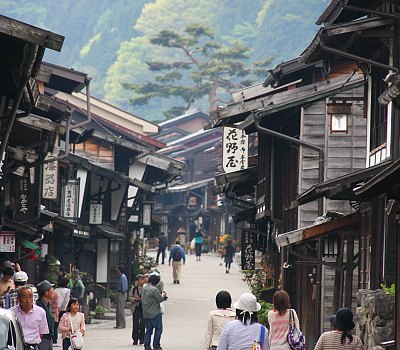
With out bellies full, we drove through a tunnel to get to another valley called Kiso Valley, home of the Kiso Post Towns. These towns are historical trade points of the Kisoji, an old trade and travel route connecting the old and new capitols, Kyoto and Tokyo. The town we went to was called Narai, which was the richest of the Kiso Post Towns back in the day. It turned out to be more boring and less authentic than I was hoping. The preservation area itself was only a single strip running through an obviously more modern town. Many of the "preserved buildings" were merely more modern buildings disguised as traditional ones. The road is paved with cement, and cars swerve through occasionally. The box style lamps hanging from the buildings seem traditional, until you realize they run on energy-saving compact fluorescent bulbs. The place was pretty deserted, as it was a cold and windy day. Many of the places were closed, and the places that were open tended to be shops selling stereotypical Japanese trinkets for exorbitant prices. I will not pay $30 for a little wooden comb, thank you very much. The whole place just reeked of "tourist trap." It was such a let down that I didn't even feel obligated to take a picture of the place, so you'll have to settle for a stock photo.

Narai-juku on a warmer and busier day.
Taking a break from all the disappointment, we stopped in a small shop to eat some of the local specialty: お焼 oyaki. Oyaki is a fried, steamed, and flipped bun stuffed with different kinds of goodies. We ordered ones filled with pumpkin, 野沢菜 "nozawana" pickled greens, and しめじ "shimeji" mushrooms. They were quite good and surprisingly inexpensive, and helped to lift my mood. We took a 肉まん mean bun home with us before we left the town for good.

Different kinds of oyaki. We had the three on the left.
That night, we decided to get some pizza. I haven't had pizza since I came to Japan, so hooray! We went up to a place called Oz Pizza, which turned out to be a B&B cabin in the woods in the foothills. We ordered a pepperoni pizza, which was fresh from the wood-fired stove. It was ridiculously expensive ($35 for something equivalent to a small pizza), but it was nice to actually have some real mozzarella cheese instead of the sweet candy-like dairy product Japanese people like to call cheese.

That pretty much ended the bizarre weekend. The next day, before I got back on the bus and headed back home, we ate lunch at a local gyoza shop that Kristin had always wanted to try. It was run by a nice old lady with golden teeth, and their prices were fantastic. We both got set menus, and shared the mapo tofu and gyoza that came with them. The gyoza were tasty and stuffed to the brim, unlike the loose saggy ones with very little filling at other places. Kristin kicked herself a few times for not trying the place sooner, and we left to the bus terminal.

Goodbye Komagane, and here's hoping that we never encounter each other again!


Solo Day

This past weekend, when the weather was beautiful and possibly even considered not cold, I decided to take a day and go explore the west side of the city by myself, with nothing other than my bike. The title is a bit strange, since I tend to do a lot of stuff by myself around here, but it was nice to go out and do things at my own pace. I wanted to see how far I could get before I pooped out, since I'm hoping to ride a roughly 40-50 km trip up to Mt. Hakkoda and back during the spring.

For now, the original plan was to ride along the curving coastal highway going northwest, and see how far out of the city I could get. The day before I left, I was looking through a picture book of the region, and I happened across a picture of 野木和公園 Nogiwa Park, with beautiful bridges going across a picturesque lake. I decided I'd take a western detour to bike around the park before continuing north. I also looked up a ramen shop called ラーメン二八〇 「ニッパーマル」 (since the highway is called the 280) far down along the highway, which I could use as a rest stop/landmark.

And so, around 11:30 am after a breakfast of rice, natto, and a quarter of a honeydew, I set out. The roads in the city are bumpy and crowded, and no fun to ride. I ground through it over the bay bridge, and finally made a left in 油川 Aburakawa to get to Nogiwa Park. None of the paths going through the park are paved, so I stayed along the road that winds around it. The lake itself had not yet completely unfrozen, and still had large chunks of ice covering most of the water surface. I wonder if there are any ice skating activities here during the deep winter, although perhaps the deep snow and not-quite-low-enough temperatures make it impossible. Even though the ice wasn't all melted yet, the lake shore was teeming with fisherman, so I guess this is a local fishing mecca.

Nogiwa Lake, filled with slushy water.

I took half a loop around the east side of the park (which ended in a dirt road), and then wound back around to the west side. I saw a road sign and asked myself, "Do I want to go to 五所川原 Goshogawara?" which is maybe 40 km to the southwest. I thought about it, and decided, "Nahh..." but then I saw the road...

Sweet mother of road biking...

Luscious curves and gentle hills, occasionally enveloped in green pine forests and lined with unadulterated white snow like icing on a cake? How can anyone resist that? So, I rode up this winding, silky smooth, and absolutely empty road for a few miles until I hit a roadblock that said, "Closed for the winter." So that's why it was so empty...

Having been forced to turn around, I rejoined the coastal highway and continued north. A south-blowing wind of around 5 m/s made the riding slow and excruciating. I kept plowing on hoping for the ramen shop sign to appear around the next bend. After a grueling who-knows-how-long, I finally made it to Ramen 280 next to 北中). After re-teaching myself how to walk on solid ground, I stepped inside.

The place was mostly empty, except for the chef and one guy in the corner taking his sweet time reading a magazine. This was great, because I could stretch my poor legs without people judging me. I ordered the shop's specialty, 味噌担々麺 (miso tantan-men) and sprawled out on the tatami in the unoccupied corner to stretch and watch some daytime Japanese television. When my food came, it didn't disappoint.

Miso Tantan-men
It had a sweet and savory flavor made through the use of lots of sesame sauce. It was also filled with chashuu pork and an indescribable ground meat that formed a pebble soup-bed underneath it all. I thought it wasn't that spicy at first, but then the mouth burning slowed my pace way down.

I checked out the wall behind me, and apparently this shop has a spicy ramen challenge. On the left, it says 眺望山「噴火」ラーメン Choubouzan Funka (eruption) Ramen for 800 yen. It advertises that the ramen is very spicy, but if you finish it, soup and all, in under 28 minutes, you get it for 280 yen. I think I'll pass and just come back on the 28th of every month, when the 正油 shouyu ramen is 280 yen. Notice a theme?

やんべ、やんべ、チョウやんべ!
Anyways, after chilling out here for about an hour, I finally felt ready to go again. I started heading north even further, but the wind demoralized me so much that I turned back around after a kilometer or so. The ride back home was fast and easy with the wind behind me.

After getting home, my legs were surprisingly fine. I'd clocked in a bit more than 40 km, and yet 2 days later I still don't feel anything especially sore. I'll probably still need to do some more training before taking on Hakkoda, and I'll try to go further down that fine road towards Goshogawara once it opens up again. In any case, I felt a bit accomplished, even though I spent the entire day by myself. I'm used to it by now, I suppose, but it'll be great once my girlfriend can finally come up and live with me again.