Monday, June 10, 2013

Inaka Activities

To most Japanese people, Aomori prefecture is the land of the hillbillies. While it's not the farthest place by distance, it is still one of the most difficult areas of the country to travel to, since there is very little airline service. Tsugaru-ben, the unique dialect spoken in Western Aomori, is used by pop culture and media when they're trying to make a character sound like a helpless country bumpkin.

Aomori has been the poster child for inaka. Inaka means something like "back-country" or "rural", and is usually used in a derogatory tone. Inaka is seen as where the uneducated hicks live, technology is hopelessly behind, people grow and fish their own food, and people can get lost in the wilderness to be eaten by wild boars.

While Aomori is now very modern and is not nearly as back-country as most Japanese people think it is, there are still old remnants of a simpler time when forestry and farming were the main occupations and there was only one school in the entire city. On a trip with my prefectural office, we set out to visit some small towns where the spirit of inaka still lives on to experience the lifestyle of a more traditional time.

Inakadate:

Inakadate (look, it's even got "inaka" written right there in the name) is a small town somewhere between Hirosaki and Aomori City. One thing they are famous for is their rice field art. Viewed from the tower nearby, the fields are planted meticulously with rice that grows different shades of leaves. Using that alone, they can write inspiring words and even recreate iconic images. This time, they decided to use the famous image of Marilyn Monroe with her skirt billowing over a subway grate. After the rice has grown to full size, we'll be able to come back and see what it looks like.

You can already see what it's supposed to look like.

Observation tower for autumn viewing

Arriving around 9 am, we gathered with the other volunteers for the opening ceremonies and then set out to work. As you can expect, walking in the inundated fields is filthy. Most of the local grannies and granddads wear deep fishing boots and cover the rest of their body in clothing for sun protection. For the rest of us, we stripped to shorts and T-shirts and waded into the thick mud barefoot. The fields themselves are filled with swimming tadpoles and mosquito larvae, and there were several frogs hopping about trying not to get squashed. If you're squeamish about getting dirty or critters/creepy crawlies, this probably isn't for you...

Down and dirty

Washing our feet in the gutter

Granny army in full combat gear

Personally, I had a lot of fun. The work itself is straightforward: they show you how to plant the rice, and since there are a lot of volunteers, the whole field is usually done within an hour or 2. Lots of the volunteers are Asian foreigners in Japan for study abroad and the like, and the local children and middle schools get in on the action too. The local middle school kendo club went in with their traditional practice garb, and they emerged completely covered in mud. Lots of little toddlers where playing and rolling around in the sludge without a care in the world. They spent the last minutes of the event horsing around with water hoses and cleaning themselves off.

After the work was done, they served us some free lunch of tonjiru (pork soup) and onigiri (rice balls). One we had finished eating and chatting on the sunny lawn, we headed to our next location.

Kuroishi:

A short drive later, we arrived at a quaint little village somewhere in Kuroishi (a bit to the East of Inakadate), which means "black rock." The bus pulled up to what looked like a warehouse of an abandoned building. We soon found out that it was actually a dance studio, and that we would be learning a traditional line dance called yosare. Performed during the Obon Festival season, Yosare, as explained by the instructor, is one of Japan's 3 great dances (whatever the hell that means). All I know is that it's a lot of fun.

The instructor explained that the word "love" is written on the back of the garb because festivals tend to be where love blooms and couples are formed.

This is how line dancing works during the Obon festivals: a repetitive and lively music plays while dancers in traditional getup make their way down the street. There is a specific sequence of moves that cycle continuously until the music ends. Depending on the dance and song, the sequence can be short and sweet or very long. 


I've done this kind of line dancing at an Obon festival in Los Angeles before, where they had instructors teaching people during the festival itself, so I knew what to expect and learned quickly. Maybe it's just because I really like dancing. It would be really cool if I could participate in the dancing during Obon season, but alas I have no connections in Kuroishi.

During our breaks, the teachers busted out a box of home-grown apple juice and shared it with everyone. Mmm... Aomori apple juice is the best!

Cloudy unlabeled apple juice is the best apple juice.
After dancing, we took a short walk down the street through the onsen district. We all piled into a minshuku, or something like a Japanese bed-and-breakfast. They told us to wash our hands and don aprons/bandanas so we could start making a traditional confection: unpei.

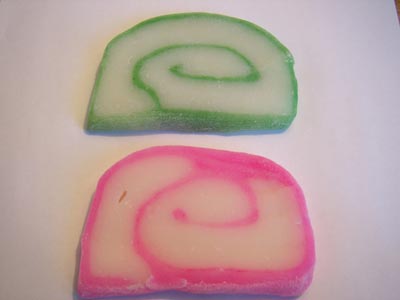
Unpei is pretty, but very simple: it's just rice flour, sugar, and water. They use food coloring to give it a little swirl in the middle to make it look like a roll-cake.

Not my picture, but looks very similar to my unpei.

While the concept is simple, making unpei is particularly strenuous. The dough must be kneaded until it's of a smooth consistency. Out of everyone, only one person managed to make it completely smooth, while everyone else had somewhat grainy dough. Maybe it had something to do with the ingredient proportions.

Next, the dough is separated into 1/3 and 2/3 portions. Each is thrown into a plastic bag, and the smaller portion has food coloring added to it. Then, you flatten the sticky dough inside the plastic bags until they are flat rectangular slabs of equal dimensions. This flattening process, done mostly by hand because there weren't nearly enough rolling pins, took us 20-30 minutes! I was damn near exhausted by the time my dough was properly shaped.

Finally, the dough strips were cut out of the plastic bags, placed on top of each other, and rolled up like sushi to complete the long unpei log. To serve, just slice it like bread (dense, sticky bread) and coat with some rice flour.

The confection itself tasted a lot like sweetened mochi, but I wasn't a big fan of the stuff because it was too sweet (it's half sugar!). All the Japanese people around me who ate it said, 「懐かしい味だ」, which means "what a nostalgic flavor!" After I got home, I sliced the roll and gave it to my neighbors at the Tenrikyou temple because they have a lot of kids (yeah, they loved it, unhealthy bastards). They ended up inviting me to stay for dinner, so I took them up on the offer.

This trip into the boonies was a lot of fun, and totally worth the experience of doing inaka activities and meeting some new international people. I wonder what will be in store for me next time...
Thursday, June 6, 2013

Springtime in Aomori

I may not have explained before, but school festivals are considered "work" for teachers and students. After the undoukai, the kids and teachers get to take a day off sometime in the next week. We ALTs, however, are not officially "teachers" and showed up at the sports festivals voluntarily, so I did not get the luxury of having a day off (let alone 4 days for all of the ones I went to). My boss decided it was only fair to give the ALTs four hours off one day to even the odds.

I decided to take my 4 hours off on a Friday afternoon when I didn't have classes. After lunch, I biked home and basked in the glory of the warm sun. I then noticed all the beautiful flowers blooming around me, and decided to grab my camera and head back out for another bike ride. Here are the photo gems I captured on my ride, along with others from a previous ride:


Oh, Japan. You pour snow on me for 5 months, and make me cower in your cold, bleak wilderness underneath bare, craggy tree limbs. Then, in the span of a week or two, you bombard me with all this overwhelming beauty and vivid color. I now understand why Japanese people have so much pride in their distinct four seasons; they are truly formidable, especially up here in the wild north.

Thanks for reading! Next time, I get down and dirty in some rice fields.

Wednesday, June 5, 2013

Undoukai - Sports Festival

Before I start, I'd like to say that, even though I mentioned before that I'm not allowed to post pictures or videos of my students or school functions, the pictures and videos in this post are of an event that was open to the public. There are several hundred, if not several thousand, recorded media of this event roaming freely somewhere, so I've taken the liberty to post some on here.

In Japan, the period from the middle to the end of May is sports festival season. Sports festivals, called undoukai or tai'ikusai, are times for the students to engage in friendly competition while showcasing their school activities and physical abilities to their parents, relatives, friends, and neighbors. The students are divided into different teams. In elementary schools, there are only 2 teams (red and white), while middle schools have 3-4 teams (of any colors).


First, there are opening ceremonies. The students march around the track like tiny little armies, waving their arms and stomping their feet in unison. Each team and class waves their own flag around, and there's a lot of pomp and circumstance. After the students have lined up, there are several speakers who officially open the sports festival.


After opening ceremonies, it's time for rajio taisou, which means "radio gymnastics (or calisthenics)". While music is played (one of my schools played Backstreet Boys!), the kids go through a set routine of moves to stretch and warm up before rigorous exercise. Most of the kids in middle school just half-ass it because rajio taisou is viewed as childish.


Some schools continue from rajio taisou into a performance routine. The kids get into formations, climb on top of each other, and strike poses. I'm not sure what the purpose of this activity is, but maybe it's some kind of team-building exercise.


The main events of the sports festival consist mostly of running. It doesn't take any special skills to run, so all the students can participate together. There are 100m sprints (70-80m for the smaller children), various relays, longer distance runs (800-1000m), and what Japanese people like to call a marason. The general accepted definition of "marathon" around here is "a long distance run", which can be anything longer than 1 km. The "marathon" at my elementary school was 1.3 km long, rather than the traditional 26 miles we English speakers are used to. Anyways, here are some cool running action shots:


Besides running, there were a variety of obstacle courses. Some were your standard obstacle courses, like crawling under nets, jumping rope, walking a balance beam, rolling a giant rubber ball, or hopping through ladders and hula hoops. Some involved running with parents and other teachers. There were several different options: run with a ball hugged between them, each person squeezed into one leg of an oversized pair of shorts, or with legs bound into a 3-legged race. One of my elementary schools even had a "recycling" obstacle course, where kids needed to crush cans, or sort items into the right bins before moving on.


And of course, a sports festival wouldn't be complete without some tug-of-war! The tug of war here is a little different, in the fact that the "goal" flags are placed tangentially from the rope, and the kids pull the rope laterally instead of in a straight line.


Each grade participated in their own special events also. The tiniest 1st graders had a ball and basket competition. Soft foam balls were laid in a circle, and the kids tried to throw as many into the central basket as they could. This game is something like the definition of adorable:


Middle school first years competed in a tarp-dragging race. All the students stand on the tarp and need to hop in unison so the pullers can slowly drag the tarp across the finish line.


The second years had a long jump-rope competition.


The third years had a "caterpillar" race. All the students in one class bound their ankles to two ropes, and had to move down the track by taking steps in unison.


My favorite was probably the 3rd year multi-event match. This consisted of a long human bridge, a 5-legged race, a team adviser tarp carry, and finally a sprint to grab the finish flag. It's hard to describe, so just watch it:


Somewhere in between all of these, there was a cheering competition called ouen gassen. The kids had practiced their routines for weeks, and used pom-poms and megaphones to dance and chant. This was a surprisingly big deal, as the winners of the ouen gassen received separate trophies from the main sports competitions.


At the end, they announced the winning team based on the results of all the sporting events combined. Since this is the last undoukai for the third year students, there was some crying as well. Finally, the principal said some final words and officially brought the sports festival to a close.

Afterwards, most of the kids and many of the teachers had horrific red sunburns on their exposed skin. After all, many of them hadn't been exposed to sunlight since the snow began falling in November. I had made sure to put sunscreen on, and I don't burn easily to begin with, so I was luckily fine. I'm just wondering how much darker my students will look when I see them again in a few weeks.

I teach at a total of 5 schools, but I was only able to go to 4 of the undoukai (some of the elementary schools overlapped). While it was fun while it lasted, my weekends were properly consumed by these 7-hour-long events. I'm kind of glad they're over so I can get my relaxation days back.

That's all for the sports festival! See you again!

Saturday, May 18, 2013

Golden Week Part 4: Hirosaki Hanami

(continued from part 4)

Today, we were finally going to Hirosaki! Hirosaki, about 30-40 km west of Aomori City, used to be the capitol of the Tsugaru region, and is well known for it's castle grounds and reconstructed castle keep. However, it's most famous for its sakura cherry-blossom viewing season. Way up here in the north, the sakura season is later than most of Japan, and it usually coincides perfectly with then Golden Week holidays, making Hirosaki a big travel destination. Also, since it's colder up here, the different species of sakura tend to all bloom together, instead of separately like the southern areas.

We all overslept because of the previous night filled with gyoza, but we left as soon as everyone had gathered their things, which ended up being around 11 am. We had skipped breakfast, so we bypassed the castle by a little to eat lunch at Stamina Tarou! Stamina Tarou is what's called baikingu, or "all you can eat." Their main thing is yakiniku, or meat barbecue, but they serve damn near anything. They've got sushi, takoyaki, ramen, salads, crepes, ice cream, and even a cotton candy machine! Of course, I didn't come here to eat stinking takoyaki, so I stayed pure, filling up with only grilled meats and vegetables. Kevin was too impatient to wait for all his meat to cook, so he scarfed down 4 potato croquettes and later regretted it.

As you can see, the grill isn't quite big enough for more than 2 people.

After our 90 minutes were up (yes, you only get 90 minutes), we headed straight towards the castle grounds with Kevin complaining about the road bumps giving him a stomachache. Parking was a nightmare, but we settled for paying 1000 yen to park in an empty lot near the park. It was a bit rainy, but the flowers were beautiful. It's too bad that the darker pink "willow-type" cherry trees were still only budding.


During the sakura season, there's a big festival going on in the park, and you can buy all kinds of yummy goodies from the stands that pop up everywhere. You can also rent rowboats and row around in the sakura-lined castle moat, but we opted not to because it was still cold and rainy.

Festival food stand. They are everywhere.

We only stayed for about an hour and a half because we needed to return the rental car that day. The drive back to Aomori City was clogged up with traffic (it being the last day of Golden Week and all), but we still managed to get back with some time to spare. Since the day was pretty chilly, we went to 極楽湯 Gokuraku-yu onsen to warm ourselves up again.

Gokuraku-yu, unlike the other onsen we've been to, is more like an amusement park than a bathhouse. When you walk inside, the ticket machine, which would only have buttons for "adult", "child", and "shampoo/soap/towels" at normal bathhouses, were FILLED with buttons for various baths, spa treatments, massages, and therapies. They even have therapy fish, which is just a that you dip your feet into so the little fishies can nibble away at your dead feet-skin. Outside the main bathing area itself is something that can be described as a food court, where you can buy drinks from vending machines or ramen/curry/tonkatsu from the cafeteria.

The bathhouse itself is large and extensive. They have many rows of showers, and plenty of pool space. There are also underwater benches and reclined seats that blow jets of bubbly water all over your body, but some of them are poorly placed. I laid down in one and just got relaxed, until a cold water droplet that condensed on the ceiling nailed me right in the eye. Talk about unpleasant...

Outside, there is a large rotenburo, or outdoor bath, along with some stone seats that slowly trickled water down your back. There were also a few single-person stone tubs that looked like huge flower pots. I felt like these were the nicest, but probably only because the water in these tubs were the hottest in the whole bathhouse, even though they still weren't very hot. I like my onsen to be around 42-43 C, but the ones here barely got up to 41.

Past the outdoor bath area was another small building. Inside rests the "special" bathing area, which offers seasonal bathing in different kinds of water. The day we went, they were offering a "grape bath". The water was a murky purple and smelled like watery stale wine. It was a little off-putting in my opinion, but I've heard that other baths offered, like the apple bath or rose petal bath, are very pleasant. Overall, I personally wasn't really digging the commercialized feel of the place, so I probably won't be coming back very often.

We spent as much time as we could bathing before we had to leave and return the car. I managed to refuel and return the rental car with less than a minute to spare, which was a little terrifying. With the car returned and the next day a work day, my Golden Week was officially over. My 2 friends stayed at my place for the next several days and explored the city on their own, and they finally left for Tokyo on the Thursday of that week.

Well, as guess it's back to living by myself and teaching classes at school. I cant wait for the next long vacation, and I wonder where I'm going to explore next! But, wherever I go, you can be sure that I'll share it with you here on my blog. Thanks for reading, and see you again!

Thursday, May 16, 2013

Golden Week Part 3: Shimokita Peninsula

(continued from part 2)

The day after our somewhat wasted trip to Hachinohe, we headed out early for our trip through the Shimokita peninsula. With a reservation at a ryokan (Japanese-style inn) deep in the mountain woods, we were in for a step away from civilization.

Aomori prefecture. The yellow hatchet on the upper right is the Shimokita peninsula.

We started the day off right. For breakfast, we headed downtown to the 魚菜センター gyosai center (lit. fish and vegetable center) to get Nokkedon! If you are unfamiliar with Nokkedon, see my previous post here. I ended up with a rather small bowl this time, since I splurged on some 大トロ fatty tuna. Mmmm... totally worth it.

After breakfast, we started on our long journey. It was another long drive eastward towards Hachinohe, but this time, we split North at Noheiji and ended up on a nearly empty highway. An hour of driving through rural countryside filled with wind farms later, we arrived in Mutsu city. Mutsu is the largest city in the area, but it still can hardly be called urban. We weren't hungry yet from our massive breakfast of raw fish, so we decided to continue on to our first destination of interest: Osorezan.

Osorezan 恐山, which can be translated into "Fear Mountain", is one of the 3 holiest sites in all of Japan. In the middle of the forest and mountains, there is a lake with water too poisonous to drink, let alone even swim in. On one of the beaches lies a rocky barren coast, with sulfuric vents and bubbling pools. This place is considered a perfect representation of Buhddist hell because it is surrounded by 8 peaks (like a lotus flower) and has 108 bubbling sulfuric pools (to represent the 108 wordly evils). There is a temple built on the site, which you can enter for 500 yen. Inside, there are several sulfuric pools housed in bathhouses that you can freely take a dip at your leisure (if you're okay with smelling like rotten eggs for the rest of the day). During the warmer seasons, there are mediums here that offer services to communicate with dead loved ones. We spent a decent amount of time here, exploring the various pools, stone jizou statues, and piles of stones and toy windmills (offerings to the jizou to help deceased children reach the afterlife).

Hellish coastline

Temple grounds

A truly formidable spiritual site.

I forgot what time we were supposed to get to our ryokan, and ,while trying to look it up on my smartphone, discovered that there was absolutely no cell phone reception. Truly, this must be hell.

We continued forward, and after another half an hour of winding mountain roads, we finally arrived at our resting place for the night: Yagen Valley. Yagen valley is probably the least developed space in Aomori prefecture, and maybe even the entire main island of Japan. All that's there are trees, rivers, a couple inns, and hot springs. It was a really quiet and relaxing environment, and we basked in the scent of the trees as we checked into our little ryokan. I chose to stay at a ryokan called 薬研荘 Yagensou because it was relatively unknown and much more traditional and inviting than the more conventional Hotel New Yagen around the corner. The prices are also hard to beat compared to other ryokan. Here's the website where you can get more info and make a reservation, but it's entirely in Japanese, so be warned. We found the owner woman, who led us to our rooms and sat chatting with us (mostly me) while pouring us some green tea.

Checking in to Yagensou
Since there was still an hour or two until dinner, we went looking for the onsen in the area. By recommendation of the ryokan lady, we decided to go to Meoto Kappa no Yu 夫婦カッパの湯. She told us it was walking distance, but afting searching to no avail, we hopped into the car and drove around looking for it. It turns out it was 2 km away, instead of the 200 m the lady had told us. In any case, we paid our small fare of 200 yen and trotted down into the riverside bathing area.


Once inside (after figuring out how to open the door), we bumped into a dad and little sons about to leave. It was a beautiful outdoor open-air bath, and once the other people left, we had the place to ourselves to take pictures. We were originally only going to take pictures of the bath, but then we thought it would be funny to have a risque naked photo shoot to entertain our friends back home, who are not acquainted with public bathing and nudity. Hopefully, this won't ruin our reputations back in the States...

Gorgeous!

Bucket censorship.

Yeah!! Naked freedom!!

More bucket censorship.
After the bath, in which my girlfriend had the entire women's section to herself, we went back to the ryokan for dinner. We changed into yukata, gathered in the larger of the 2 rooms, and were served a feast! This was also the first time Kristin and I had tried sea snail, so it was an interesting experience.

From bottom right to top left: scallop and sea urchin soup, pickled napa cabbage,  yellowtail and sea bream sashimi, cantaloupe, squid tentacles, clams, sea snail, some type of mushroom with sesame seed sauce, some type of mountain vegetable with ground horseradish, grilled fish (trout?), rice, and my personal favorite, wild mushroom nabe hotpot (with 10 different kinds of mushroom).
After dinner, they took our trays away and set up our bedding for us. We took another bath (for real this time, since the outdoor onsen didn't have any soaping/shampooing areas) in the bathing facilities in the ryokan, which didn't even have showers. I later heard from the owner that since the hot water comes straight from an underground hot spring instead of a water heating tank, there is only enough water pressure for faucets and not shower plumbing. It didn't matter to me, since filling small tubs with hot water and dumping them on yourself is oddly satisfying.

We spent the night comfortably and woke up the next morning for breakfast. Though not quite as fancy as the night before, the meal was excellent, and we got to try some more local delicacies, like shredded nagaimo and another gooey vegetable concoction that I can't quite remember. The owner was surprised that we foreigners enjoyed the gooey, slimy foods of rural Japan, since most American and Australian tourists are uncomfortable with the texture.

With breakfast finished and our plans to go hiking thwarted by the rain, we said goodbye to the ryokan owner and piled into the car to head further northward. The target: Ouma Town on the northern-most tip of the main island of Japan. We arrived just before lunchtime, and made it to the tip of the cape to take pictures.


If you don't know already, Ouma is a very famous tuna fishing town, and the tuna caught here are usually sold for upwards of 30,000,000 yen ($300,000) each! One shop in the area was built by a fisherman who sold a catch for over 350,000,000 yen! That's $3.5 million! Most of the stuff being sold was rather expensive, so we held out on spending until lunchtime. At lunch, Kristin and I shared a bowl of expensive 中トロ (medium fat tuna cut) and 大トロ (high fat tuna cut), while Kevin enjoyed a nice large plate of tuna curry.

Tuna "tsukushi-don" まぐろつくし丼

Savoring some 大トロ. Look at the food-gasm face Kristin is making!

Good-looking maguro curry.
With the tuna-tasting mission completed, we headed back east towards the Eastern tip of the peninsula: Cape Shiriya, also known as Shiriyazaki. The reason we'd go out of our way to this sparsely inhabited place is this:


Wild horses! Not only are they wild horses, but they're the burlier, stockier, hairier versions famous in the area. These snow horses, called 寒立馬 kandachime, graze the plains on the cape, even when blizzards are dumping snow on them deep in the winter. They don't look like much in the pictures, but they're MASSIVE in person. The height to their backs alone is over 5 feet! They're very gentle and let people pet them, but their size alone is intimidating. Here is Honeybunny cautiously approaching one of the gentle giants:


She kept saying, "It's going to bite me!" as the horses crunched heavily on the grass. I decided to muster some courage a get a little more friendly, but the sight of those massive hooves - which could knock my skull concave in one swift kick - was still a bit unnerving. Needless to say, I made sure to stay away from the rear of the horses.


There's also a lighthouse that marks the Eastern-most point of the cape, but we mostly bypassed it because we really needed to use the bathroom and we wanted to make it back to Aomori City in time to catch the festival at Gappo Park. We made it back in time to enjoy some of the festivities, but we missed the Yosakoi dancing. Oh well...

That night, Kristin had to get on her bus back to Nagano. As a sendoff, we drove back downtown and ate at a little bar-style shop that served 6 different kinds of gyouza, or "pot-stickers". The special ones to note were the black gyouza (made black with seaweed), miso curry milk gyouza, and their house specialty which I have a hard time describing, gyouja. One of the drunker customers also treated Kevin and Wesley to some Japanese liquor, like Hoppii beer-like malt beverage and nihonshu Japanese sake.

After dinner, I drove Kristin to the bus terminal, where we had to say our farewells. It's always an emotional and sad parting, and the street performers loudly singly dramatic songs didn't help. For her, Golden Week was over, but I still had another day of responsibility to show my guests around.

Next time, it's finally time to go to Hirosaki! See you then!