When I first came to Japan, I got used to the whole public bathing thing pretty quickly. I also gained a greater appreciation for hot spring baths, and I began looking around for new and interesting onsen to visit. I've been to onsen all over the country, from Hokkaido to Kyushu, indoor and outdoor, local public bath and exclusive bath for overnight guests only. During all my research, there was one hot spring I thought I would never have the opportunity to go to. That was Aoni Onsen.
よぐきたねし yogukitaneshi: sounds dirty, but means "welcome" in tsugaru dialect
Aoni Onsen 青荷温泉 is a collection of several cabin-like lodges deep in the mountains of Kuroishi. For a long time, they operated without electrical power, so they burned oil lamps for lighting. This earned them the nickname "Lamp Lodge", or ランプの宿. These days, there is electricity to run telephones and basic lighting/heating/ventilation, but they still hold to tradition by burning oil lamps for lighting at night.
Iconic lamps of ranpu no yado
Even though Aoni Onsen is quite famous, it is one of the most difficult hot springs to access. Back when I didn't have a car, access was pretty much impossible, as there is only one bus that services that location (and it doesn't service Aomori City). Even by car, it's an hour and a half drive from Aomori City. During winter, the single narrow road that runs the 6 km to the onsen from the highway gets shut down because of massive snowfall, so the only way to get in is to ride the hourly shuttle provided by the lodge. They used to use a snowmobile-like tractor to transport people, but they've recently switched to using a 4x4 elevated bus.
Discontinued snow vehicles (not my picture)
The bus they use now.
With access being this difficult, I though I'd never get to experience such an interesting and unique place. Now that I have a car and better Japanese skills, I figured I'd give it a shot and booked a day trip for the day after New Years. You can come anytime during the year and autumn is very popular, but I wanted to go during winter because it's absurdly beautiful.
After driving for an hour and a half through snowy highways, we arrived at the parking lot in front of 虹の湖 nijinoko, or "Rainbow Lake", just before 10 am. There, the bus was waiting for us (and only us), and we hopped on with all of our bathing supplies. The bus climbed the treacherous slopes for 15 minutes before arriving at the lodge and letting us off.
The main entrance
It seems like day trips aren't very popular, so the place was almost empty. The whole day, there were only ever 2 people max with me in the baths, while Kristin didn't see a single bather the entire day. We checked in at the front desk and proceeded to investigate the 4 different bathing spots. As we walked outside, we caught a glimpse of the scenery we came to see.
So beautiful it hurts...
The first was the outdoor bath, or rotenburo 露天風呂 in Japanese. It's one of the few mixed-gender bathing spots left in Japan, although there is a "ladies time" reserved for the shy girls (damn them). There are two changing rooms (closets, more like) right beside the bath and no showers. We quickly changed and ran through the biting cold into the main pool. The water was warm, but not very hot, which is the same for most of the baths here.
Mixed bath! =] Ladies time... =[
There is a proper bath just up the path from the rotenburo. While there still are no showers, there is body soap and buckets to dump water over yourself. The main attraction here is the view of the waterfall that feeds the stream running through the property. I noticed a small outdoor pool as well, so I ran out the door and hopped in. I soon regretted it, as the water was below body temperature, and I retreated back indoors.
Waterfall in the back. Don't be fooled by the pool ... it's cold!
We took a break from soaking by having our pre-ordered lunch. We sat in a large tatami room deemed the おしゃべりホール, or "chatting hall". There were a few other people in there waiting for food as well, but none of them were talking. So much for chatting...
し~~~ん
The food was good, but probably would seem strange for someone not accustomed to country cuisine. My 山菜定食, or "mountain vegetable meal", was chock full of slimy wild mushrooms (which are one of my favorites). Kristin's 川菜定食, or "river vegetable meal", had it's share of slimy mushrooms, but also came with a particularly yummy grilled fish. There were also the usual pickled vegetables, with the daikon radish one being particularly adorable.
3 kinds of slimy mushrooms and one kind of slimy plant. Aomori people sure love slimy food!
The pickled daikon is the shape of a horsey!!
After lunch, we finished up the final two baths. One, in a building on the other side of the entrance, was the most comparable to a rustic hot spring bath. It had soft wooden boards surrounding a rectangular basin in the middle. The water was noticeably warmer here, which I appreciated. The girls side apparently had an outdoor bath too, but Kristin informed me that I wasn't missing out on much.
The final bath was a small one inside the main building. The water here was the hottest of them all, but the bath was only large enough to fit 3 or 4 people tops. We got our body temperatures high enough to brave the outside cold before packing up our things and calling it a day. We waited for the final bus out of there (at 2:40 pm) with several of the other guests that had stayed overnight, and finally witnessed a bus full of photo-taking guests arrive. I guess most visitors choose to stay the night instead of making it a day trip.
We had spent about 4 hours at the onsen soaking, relaxing, and eating. It was great to see the beautiful scenery, but the baths themselves were somewhat disappointing. I was especially hoping they'd be hotter, but only one or two were at a temperature I liked. I'm still debating whether I should come back, but I think it's an experience everyone should have at least once.
If anyone is interested, here is their website with information. Sadly, it's Japanese only, so good luck. During winter, they have a special pricing plan for both day trips and 2-night stays. The day trip plan that we used lets you get onsen access and lunch for an extremely reasonable 1,200-ish yen (many famous onsen will charge that or more for bathing ONLY), but you must call and reserve. Their 2-night 7-meal plan is also extremely reasonable compared to prices for other ryokan/minshuku, but it's only recommended for people trying to escape from the hustle and bustle of civilization for a while. Can you survive that long with no power, cell phone service, or internet? If you're not staying the night and aren't interested in food, reservation is not necessary and onsen access is 500 yen.
On yet another prefecture-sponsored trip, we traveled back to the east side of the prefecture, to roughly the same place as the salmon festival we attended in the fall. It's the usual long 2-hour haul from Aomori City, but it's worth it for a day of fun and an escape from deep snow.
Our first stop was at a place called アグリの里 aguri no sato, which quite literally translates into "ugly hamlet." Despite the rather unfortunate language mistake, this place is a small conglomeration of agricultural buildings, like greenhouses and animal pens. They've got cute bunnies and chickens that you can feed, as well as a goat and a pony to keep the little kids entertained.
There is a greenhouse used to grow tropical fruits, such as bananas, papaya, passion fruits, dragon fruit, and even coffee!
Papayas! In Aomori! =O
If you didn't know, coffee beans are actually the pit inside the red coffee fruit!
Since it's winter now and freezing temperatures are not suitable for growing vegetables, a few other greenhouses are reserved for out of season farming. Using hydroponics, they grow different kinds of lettuce, tomatoes, and several other greens that I couldn't quite identify.
The largest amount of greenhouse space, however, is reserved for only one plant: strawberries! Our main purpose for coming here was to pick strawberries. At first, I wondered how in the blazes we'd be picking strawberries in the middle of winter, especially at a place called "the ugly hamlet". Here in the space of 3 greenhouses combined, kids ran around the raised aisles of strawberry plants looking for ripe berries, while large bees hummed about pollinating the plants.
One of the special points about this place is that the greenhouses are built with universal design in mind. The rows of strawberries are elevated above the ground for easy picking, and the aisles are also wide enough for wheelchairs to pass through.
Besides growing food, Aguri no Sato serves the food it grows in an all-you-can-eat buffet (called viking in this country for some strange reason). They've got unique food like strawberry pizza, the freshest of salads, and vegetable curry made from the vegetables grown on site. You also get to eat your food off of a round wooden tray (I hesitate to call it a plate). It's all yours for a relatively modest 1300 yen.
Later, if you'd like to relax and unwind, they have a footbath as well. I unfortunately stepped under the water draining fountain and didn't notice it flowing all over my shoe because it was warm water, so I spend the day with a soaked right foot.
After the agricultural village, we headed toward the Momokawa sake brewery. I'm not a big fan of alcohol, so most of the experience was lost on me. We took a tour of the brewery and packaging facilities, and then sat down for a taste test. I've been to a much smaller brewery before and had some hands on experience with the brewing process, but since the preparation at the Momokawa brewery was already completed, all we really did was look around. Also, alcohol tastes gross to me, so the taste-testing was less enjoyable and more of torturous than anything. Anyways, obligatory pictures of sake!
Their most expensive, handmade sake. It's really not that expensive nor delicious...
That's all for this time! Many posts about my winter trip to Kyuushuu coming up soon!
This post, like many of my posts, is a few weeks late, but please enjoy it nonetheless!
Near the end of the fall season, several towns around the prefecture hold salmon festivals. They round up boatloads of salmon from the ocean and harvest their eggs and sperm for fertilization in fisheries later on. The "harvested" salmon that are at the end of their life cycle are then released into shallow pools at the festival site. Basically, the festival is there to entertain people as a sort of "play with your food before you eat it" activity. The festival we attended was in the town of Oirase in eastern Aomori Prefecture near Hachinohe and Misawa.
For a small fee of 1000 yen, you can participate in the famous salmon catch. Once you have donned gloves and wading boots, you and a crowd of other participants are given 5 minutes to catch the salmon of your choice. Obviously, bigger is better, but there were several fish with yellow ribbon tied to them that would earn you a special prize. There was also a "smallest fish" contest, where the disappointment of catching the smallest fish out of the lot is offset by a consolation prize.
Ready to rumble!
Video of the hunt!
As you can see, the salmon are not small critters. Mine probably measured about 3 feet and weighed at least 5 kilograms. Some participants, like the girl beside me in the video screenshot, were really hyped up to catch the fish at first, but got a little intimidated by their size upon seeing them. "They're like little sharks!" said another participant. They had sharp little teeth at the end of their snouts too!
After we caught the salmon, we waited in a long line to have the fish gutted and filleted. I felt bad as the energetic thrashing of my fish weakened until it ceased moving altogether, but such is the circle of life. =[ We packed the pieces of fish into a large cooler we brought (we were the only ones who had the sense to bring a cooler) before heading out.
Besides catching fish, there were other festivities, like all kinds of international food and a salmon race. I'm not entirely sure how the salmon race went down, but the fish were placed into narrow troughs and "encouraged" from behind by pole-wielding participants.
Since we'd already driven so far east, we left the festival and headed back to the trusty Sasaki Restaurant in Gonohe for a tasty horse meat lunch. We turned down all-you-can-eat barbecue for a taste of 馬刺し basashi, or "horse meat sashimi". I just love this buttery red meat!
Lean raw horse muscle. We DEFINITELY cannot get this in the States...
That's all for this time! Thanks for reading and please look forward to the next (somewhat delayed) posts!
Last weekend, I had the opportunity to go on a trip with a bunch of foreign exchange students to explore the area just south of Aomori City. There isn't much down there but wilderness and a few rustic natural hot springs.
Our first stop was the Hakkoda mountain range. 八甲田山 Hakkoda-san, while translated as "Hakkoda Mountain", is actually a series of volcanic peaks instead of a single standing mountain. During winter, snowfall is immense, so skiing and snowboarding is the only real activity around. While the skiing facilities are very limited and there is only one ski lift, Hakkoda is extremely popular among powderhounds who can bring their own gear and navigate the wild bare mountain faces by themselves.
The peaks are serviced by a single mode of transport: the Hakkoda Ropeway. It's a 10 minute somewhat precarious ride up to the top station, and you can view the drastically changing climate and plant life on the way up. During the warmer seasons, sightseers and hikers frequent the Ropeway, while the winter season services only the most serious of winter sportsmen.
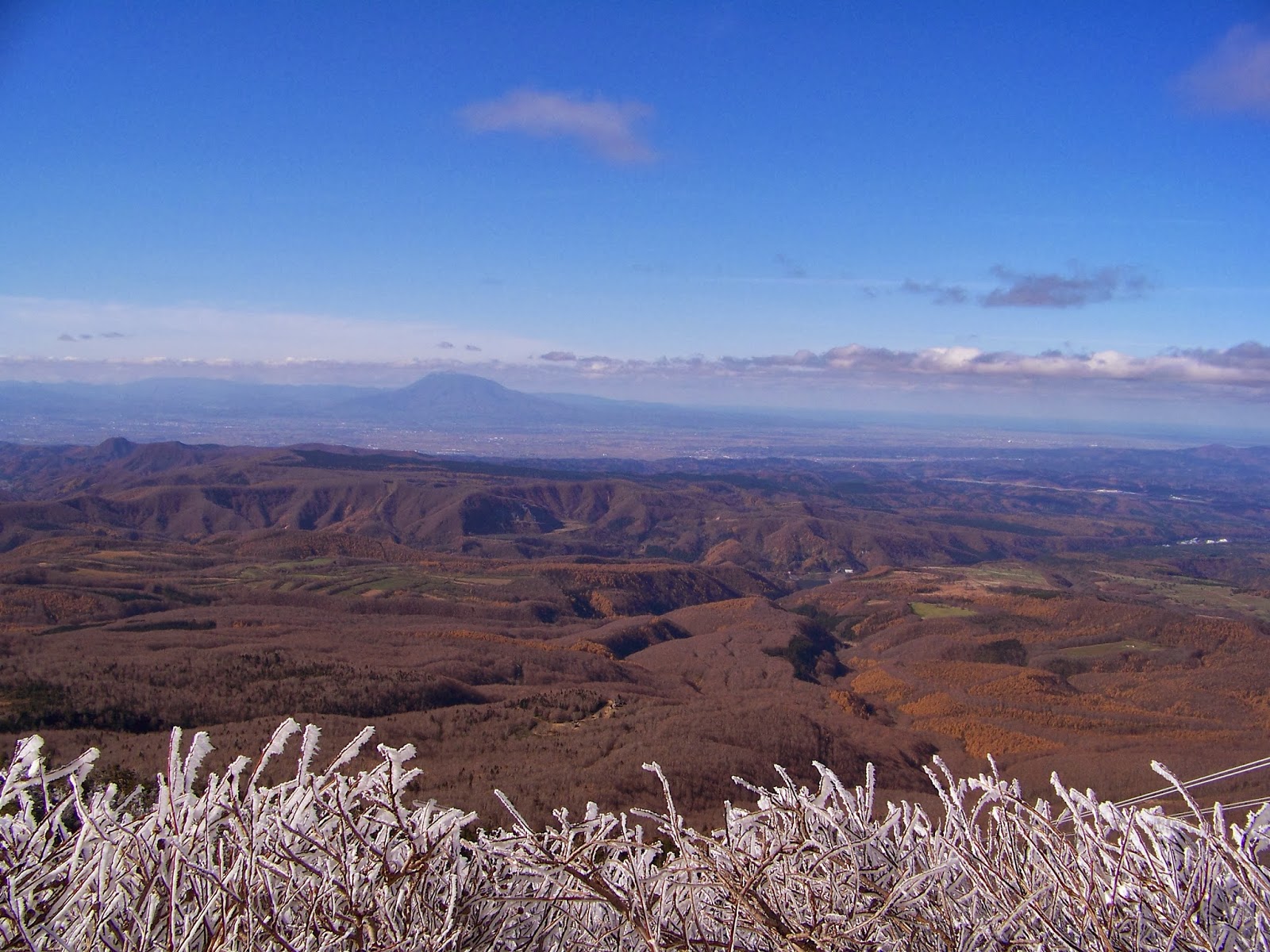
As it is still too early for snow sports, we borrowed some free boots and went out to hike the trails around the peaks. Up here, it's at least 10 C colder than it is at the ropeway base station. We were surrounded by a few inches of fresh powdery snow, and frosty ice crystals clung to the leaves and branches of the surrounding brush.
We were extremely lucky to have perfectly clear weather, so the view was spectacular. The entirety of Aomori Bay was visible from the top, and you could see west to Iwaki-san and Hirosaki, northwest to the mountains around Sotogahama, east to Rokkasho and Misawa, and northeast all the way to Mutsu! Being able to see as far as a 3-hour drive was breathtaking. That's like being able to see Mexico from Los Angeles! We could even see the faint outlines of mountains across the strait in Hokkaido!
West to Hirosaki and Iwaki-san
North to Aomori City and Aomori Bay
Northeast to the Mutsu, with Rokkasho and Misawa on the right
As we walked through the evergreen trees, the guide explained that since Aomori is so cold, we don't have to climb very high to reach an alpine ecosystem. Up here, only one tree, the Aomori fir, can survive the cold winters. The leaves on the branches are shaped like brush bristles, perfect for collecting snow and packing it into a protective igloo to shelter the tree from arctic winds. Meanwhile, the smaller flowering swamp shrub are popular among hikers in the spring and summer, but get absolutely buried in meters of snow during the winter. We strolled down the shorter "30-minute" path and enjoyed the scenery around us, but there are longer paths to see as well. Apparently, it was -3 C at the time, but the weather was so nice that it didn't feel nearly that cold.
Just gathers all the fluffy goodness!
We headed back down the mountain and returned to our bus to head back northwards toward the city. We stopped by Moya Hills to have a massive soba assortment lunch, and we looked at the beautiful fall landscape out the wide glass windows. I pointed out the Hills Thunder track to the other participants, although it seems like they already ceased operation for the winter. My need for speed will need to wait another year, I suppose.
Our next stop was in the neighborhood of Yokouchi at the very outskirts of Aomori City proper. We went down a small road that passed some dilapidated buildings and parked in an empty lot in the woods underneath the elevated bullet train tracks. Next to the lot was a small eatery with a sign "out of business". On a single sign was written "Nebuta no Sato", which pointed down an empty pathway.
As we strolled down the path through the trees and by a small brook, we heard the faint distant sound of flutes and drums. It was the music of the Nebuta Festival, which brought back many memories. Some of the other participants weren't familiar with the Nebuta Festival because they had arrived after it ended. I asked if they knew how to "jump", and then pranced around foolishly on the path to show them how (I'm fairly certain the tour organizer took a video of it).
We ended up at a couple lodge-like wooden buildings and a metal gate. Several guides came out and showed us some old pictures of Nebuta floats of bygone eras, as well as some paintings that were used as the basis for Nebuta construction. I had been to Wa-Rasse Nebuta Museum in downtown already, so I wasn't particularly impressed. We picked up our tickets and headed through the metal gate.
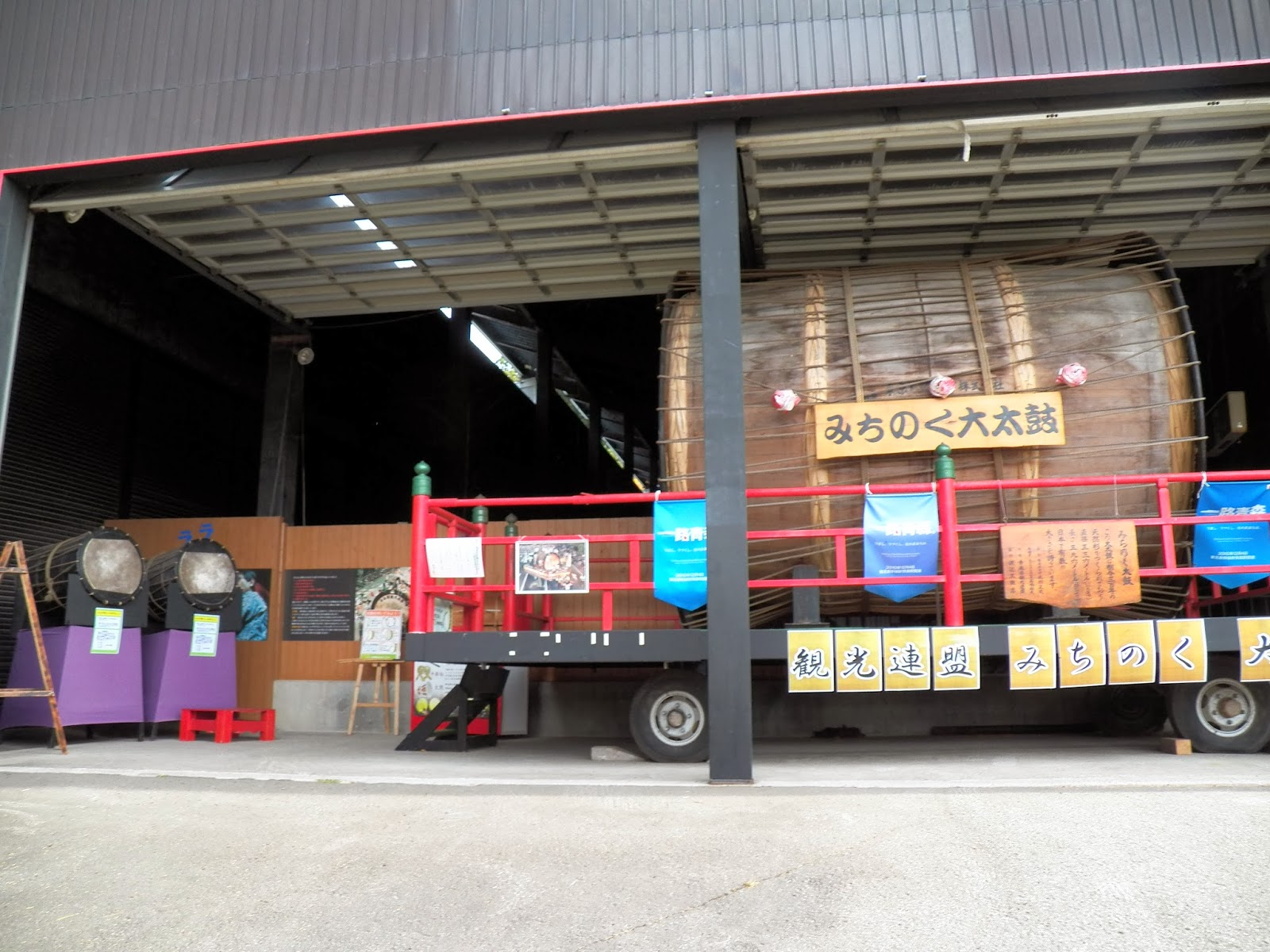
We walked up a steep slope to something that looked like a warehouse. Parked in front was a familiar sight: the 2-story high taiko drum that is the centerpiece of the Nebuta Festival. I marveled at the size of it, and told the guides I wanted to play it. They smiled and vaguely said, "That's great!" They then led us into the warehouse, where they store a bunch of winning Nebuta from over the years. Some of them were a bit dilapidated, but that's no surprise considering they're older than I am.
They brought us through the long cold building, which opened up to a huge warehouse the size of a hanger. Inside stood a huge bust from the top of a Goshogawara Tachineputa, along with a Hirosaki Neputa in the other corner. We wandered through a few more old Nebuta before they sat us down in the crafts section.
Being enlightened with the Goshogawara Tachineputa
They told us that children can make small goldfish nebuta lanterns here, but that it takes several hours and we didn't have time. I was disappointed, until they wheeled out a large wooden and wire structure. It was the bare frame of a miniature version of a nebuta float, and they handed out sheets of tough paper and cups of paste. They demonstrated how to form and cut the paper, and how to glue it on the frame. They told us to find one spot and fill it in. We were all having too much fun to stop, so we continued until we ran out of paper.
After they dragged the nebuta frame out of our hands, the led us up to a stage with some taiko drums. They also brought out a few flutes and cymbals for us to play. They taught us the rhythm, and we had a few musical sessions, stopping only to switch instruments with other people.
When we were finished, we got off the stage and sat in the seats facing a large open area. Another tour bus with Taiwanese tourists had arrived, so they sat down in the rows beside us. The guides then pointed to one of the Nebuta floats and said, "We are going to move that." Holy cow, really?!? That's awesome! "It takes at least 20 people to move it, so we're going to need some helping hands." They told us where to stand and how to hold the giant wooden guide bar, and we were off!
One we'd maneuvered it into place, we stepped out from underneath and made a circle to practice the Nebuta "jumping". A young lady dressed in Nebuta traditional garb led us in the dance, while the other guides played music. At the end, we pushed the float back to its parking spot and started to depart the building.
As we gathered at the entrance again, the guides pointed to the huge drum again and said, "Now, we will let you play the giant taiko!" Hell yes!!!!!! We all jostled for position to play the drum, but I clamored up first. I gave it a hard double thwack, and the deep rumble reverberated through the valley. Kristin joined next to me, and we played the authentic Nebuta beat with the guides on flutes and cymbals. Everyone eventually had their turn before we left and headed home.
Compared to Wa-Rasse, Nebuta no Sato is far out of the way and situated in the wilderness instead of downtown. It's big, cold, empty, filled with bugs, and a bit run-down, but I thought it was a lot more fun because of all the things to do rather than just see. The extra friendly staff there made us very comfortable as well. If you decide to visit Aomori and can't come during the Nebuta Festival, Nebuta no Sato is the place to go to experience the festival vibe and activities. You'll even get to do things you wouldn't be able to do during the real festival, like experience constructing a nebuta or being a taiko player! I would go visit again just to play the giant taiko one more time!
**UPDATE: Nebuta no Sato is now CLOSED! Only a few weeks after we visited, Nebuta no Sato closed up shop, and all the floats were moved to a different location. It's really unfortunate because there is no better or more authentic taste of the Nebuta festival outside of the week it actually takes place. Oh well...
This past weekend, I went on another tour with a bunch of other foreigners in the area. Most of them were college exchange students studying something related to the Japanese language, so my language skills were far outgunned. Even so, that wasn't going to stop me from enjoying the biggest agricultural industry in this prefecture: apples!
After gathering everyone from different pickup points, we set foot on an apple farm in Hirakawa City, a small city half an hour east of Hirosaki and about an hour southwest of Aomori City. We were basically told: "You can all pick 3. The ones that are yellow are delicious. Go!" We all looked at each other uneasily before asking how to pick them and what kind of apples they were.
The kinds of apples we picked were yellow-skinned Toki apples. Compared to your standard Fuji apple (which the farm grows as well), Toki apples have less wholesome juiciness and more sugary sweetness. We wandered through the groves looking for big apples to pick. They told us not to pull the apples, and that the correct way to pick an apple is to bend the stem and snap it with leverage.
What a beautiful apple...
Honeybunny doing the deed
Showing off our haul in front of Mt. Iwaki
After our short apple-picking session, we moved over to Hotel Apple Land, which is a surprisingly fancy hotel and tourist destination in an otherwise rural area. We went inside to first grab some lunch. They guided us to the main dining hall, and we sat down in a spacious tatami room with a giant open window facing the rice fields and apple orchards.
The hotel is rather new, so everything was shiny and gorgeous.
We were soon served a set meal of 海鮮丼 kaisendon seafood and rice bowls, tsugarusoba buckwheat noodles in a tsuyu soup, pickles, and bamboo shoots in goma sauce (my favorite) on the side.
Our purpose for visiting Apple Land was for opinion exchange to help improve their operations for foreign visitors. They wanted us to rate the taste of the food and give feedback for the facilities offered by the hotel. I chuckled a little watching them try very hard at little things like interior decoration and food selection when they didn't even have an English speaker. It seems a bit naive to think those things would make a difference if they cant assist people who don't speak Japanese. After all, only a very small percentage of foreigners can actually communicate in Japanese. I brushed that thought aside and just did what they asked.
The food itself was pretty standard. The kaisendon, topped with salmon, tuna, amberjack, bream, and salmon eggs, was tasty but small, and it paled in comparison with the fresh fish you can find at Nokkedon. We also had to remind the coordinator that many foreigners are still uncomfortable eating raw fish or meat, so having and alternative would be a good idea. The tsugarusoba was the most mediocre of all and seemed like something you could find in any noodle shop. My favorite thing in the meal was the bamboo shoots in goma sesame seed sauce because the bamboo was soft and supple like I've never tasted (and I'm a huge sucker for goma).
After food, the main coordinator lead us around the entire hotel site, which is large and has many different venues to offer. They showed us the hotel rooms, which were VERY nice (and, I can imagine, expensive), as well as the main buffet and main events hall. They pointed out the window of the 5th floor and showed us a massive female Buddhist figure perched on the roof, holding an apple above her head. The coordinator explained that they were trying to make a "power spot" there to attract visitors, and I couldn't help but scoff at the blasphemy of it all.
Finally, we headed down to the ground floor and went to the bathing areas. Here, they have some very famous apple onsen baths. Inside the baths, hundreds of apples float around in the hot water and release a nice light fruity fragrance. It's a little unnerving to willing hop into fruity water, and I couldn't help but think of it as a waste of fruit, but many people really enjoy the experience. Unfortunately for us, because of time constraints and the fact that the baths were particularly crowded that day, we had to skip the main baths. We only had the opportunity to go to the foot-bath outside.
Entrance to the apple baths
The outdoor apple foot-bath
A few minutes of foot soaking and some underwater apple soccer later, we headed to our final activity for the day: apple pie making! They led us to yet another hall and had us sit at different tables. They first gave each pair a Fuji apple and a knife and told us to peel the apple. Everyone seemed very impressed that I could peel the skin off in one long strand, even with the piece-of-crap knife I was given. I guess nobody expects men to be any good at cooking in this country.
When we were done, they told us we could just eat the apple since we didn't have time to boil the apples anyways. The provided us with slices of apple that were already prepared to be put in the pie, and we enjoyed the delicious Fuji apple after cutting it on a plate. Well, at least we thought it was a plate, but it turned out to be the frozen pastry sheet we would use for the pie. Actually, it was much closer to an apple tart than an apple pie, but let's not try to confuse the Japanese people, shall we?
We cut the sheet in half, stabbed hundreds of holes in the bottom sheet, laid apple slices on top of that, and sealed the sheets shut with a fork. Then, we got to decorate the top of the tart with the discard strips of pastry.
Laying on the apple
Decorating finished!
The chefs then took our pies and baked them for half an hour while we waited and socialized. 30 minutes later...
Tada! 出来上がり!
The tart itself was really tasty. It was very simple, just pastry and boiled apple, so it wasn't disgustingly sweet like most pastries I've had. Since we used Fuji apple instead of the more traditional Granny Smith used in America, the apple flavor was very mild and not pungent at all. They gave us two different kinds of jam to dip it in so we could personalize the flavor and sweetness. All in all, it was fun to make the pie, but it was pretty simple and nothing challenging enough to be proud of.
Anyways, that's the end for this time! Thanks for reading, and see you again!
No matter where you are in Japan, summer is the time for festivals. Last year, I only had the opportunity to go to Aomori City's Nebuta Festival. This year, I took a trip outside the city to Goshogawara to see the Tachineputa Festival.
Goshogawara is a smaller and older city compared to Aomori City. The streets are narrow and are lined with lamp posts and power lines. Because of this, they can't parade very wide floats like in the Nebuta Festival. To make their floats bigger and more impressive, the only direction is upwards! Tachineputa itself means "standing Neputa float", and some of them are towers reaching 6 stories!
Your standard Nebuta float.
And a Tachineputa float by comparison.
A relatively small one is still taller than your standard convenience store sign.
While the Tachineputa festival features the same instruments as the Nebuta Festival (flutes, cymbals, and taiko drums), they play a different rhythm and melody. They also have a different chant. In the Nebuta Festival, they say "Rasse-ra, rasse-ra!" which is supposedly derived from the war chant "dase dase!" meaning "drive ['em] out!" In the Tachineputa Festival, they yell "Yattemare yattemare!" which roughly translates into "beat the crap out of ’em!" In any case, they are all aggressive and war-related.
Getting to Goshogawara is fairly easy by train, and doesn't cost too much either (~500 yen). I am fairly certain there is a bus that runs there too. I've even considered biking there, since it's only 25 km from Aomori City. The only problem is how to get back home, as the trains and buses stop well before the end of the festival. The best option would be by car, but we made a wrong turn and got stuck in some horrific traffic thanks to a navigation blunder made by our friend. That, and you also have to park a short distance away from the actual festival route because of the crowds.
We parked at a department store called ELM about a mile away. On the way to the car after the festival, we walked alongside a river area and heard an oddly familiar cow mooing noise. We were confused at first, but a Japanese friend explained that they were frogs called ushigaeru, or bullfrogs. As we walked down the path, each successive "moo" from the river made us burst into laughter.
That's all for this time! I hope to bring you more festival footage from different places in the coming years!